What This
Makes Possible.
If reality is built at the body's edge, if a place is assembled from landmarks and movement and other people, and if meaning is made by the visitor from what a room offers and withholds, then a room can be designed as an instrument for all of it. That is the work of Qualia Forge. This is the final part of the thesis, following place and meaning.
The Room as Instrument
Most of the environments people spend their lives in were designed for something else. Theatres were built for a stage and a facing crowd. Cinemas were built for a rectangle. Galleries were built for objects on walls. Each is superb at its purpose and indifferent to the rest of what a body can do. And the newest medium, the headset, is superb in its own way, giving each person a private, perfectly responsive view of an impossible world, at the cost of the one thing this whole piece has been about: the room, and the other people in it.
Qualia Forge exists to build a different kind of place. A shared environment in which image, sound, architecture, air, physical objects and live performance are composed together, at the scale of a building, for people who are physically present, can see one another's faces, can touch real things, and can move. Not a screen you look at. Not a headset you disappear into. A place you enter together.
Think of it as an instrument. A concert hall is an instrument for sound: its proportions, materials and geometry were designed so that music made inside it would reach the ear in a certain way. A shared environment is an instrument for experience. Its surfaces are designed so that light becomes world. Its acoustics are designed so that sound has a place. Its floor, its objects and its thresholds are designed for the body's testing hand and moving foot. Its openness is designed for a performer's living timing and a crowd's contagious attention. And the whole is designed to be played: by a story, a piece of music, a ceremony, a conversation, a brand's idea of itself, an artist's vision of somewhere that does not exist yet.
A concert hall is an instrument for sound. A shared environment is an instrument for experience. We build the instrument so that others can play it.
The technologies and materials that follow are not the point. They are the strings and the soundboard. Everything in the first three parts of this piece, the fovea and the periphery, the cochlea's map, the vestibular anchor, the shortcut from scent to memory, the event boundary, the place cell, the mirrored heartbeat, is the reason each of them is shaped the way it is. The working discipline of those strings, from the grammar of the illusion to opening night, fills a companion text: the immersive handbook.
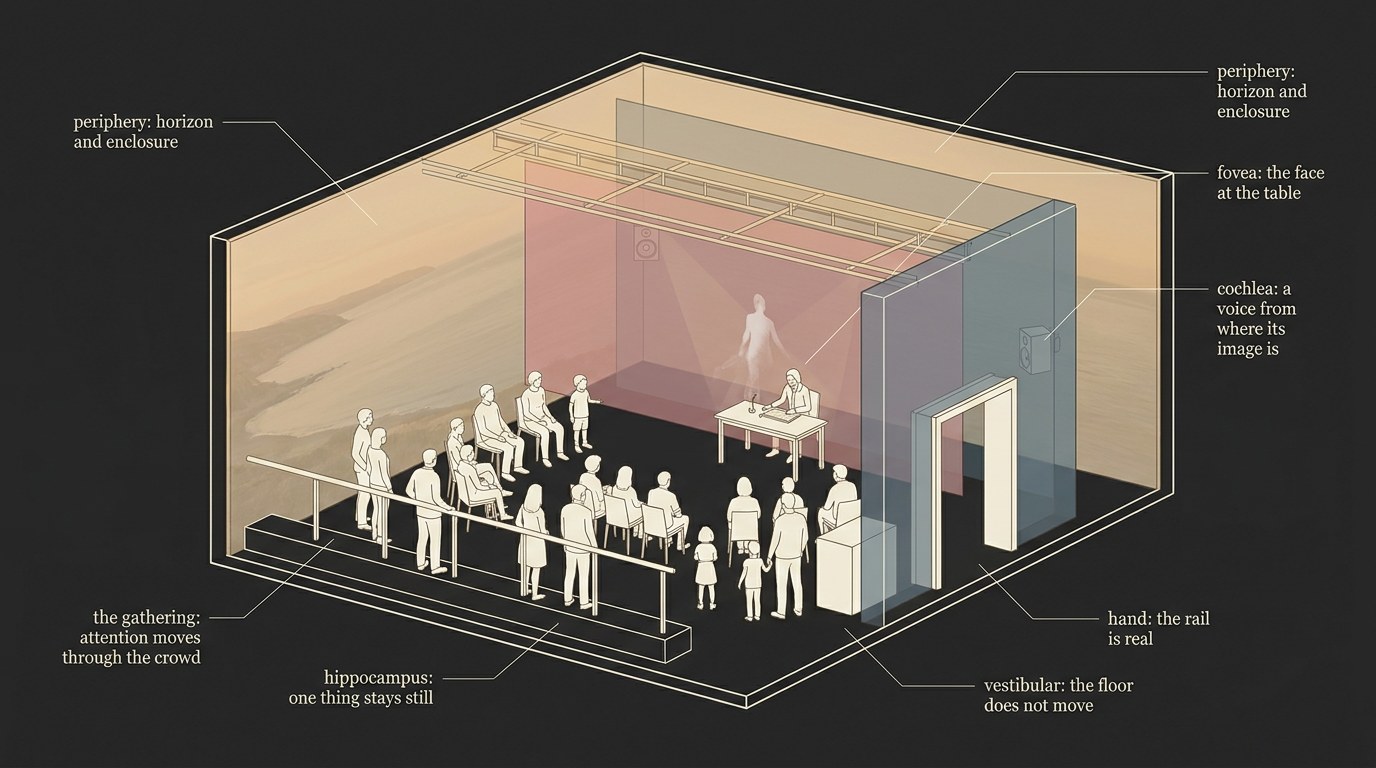
Surfaces: Where Light Becomes World
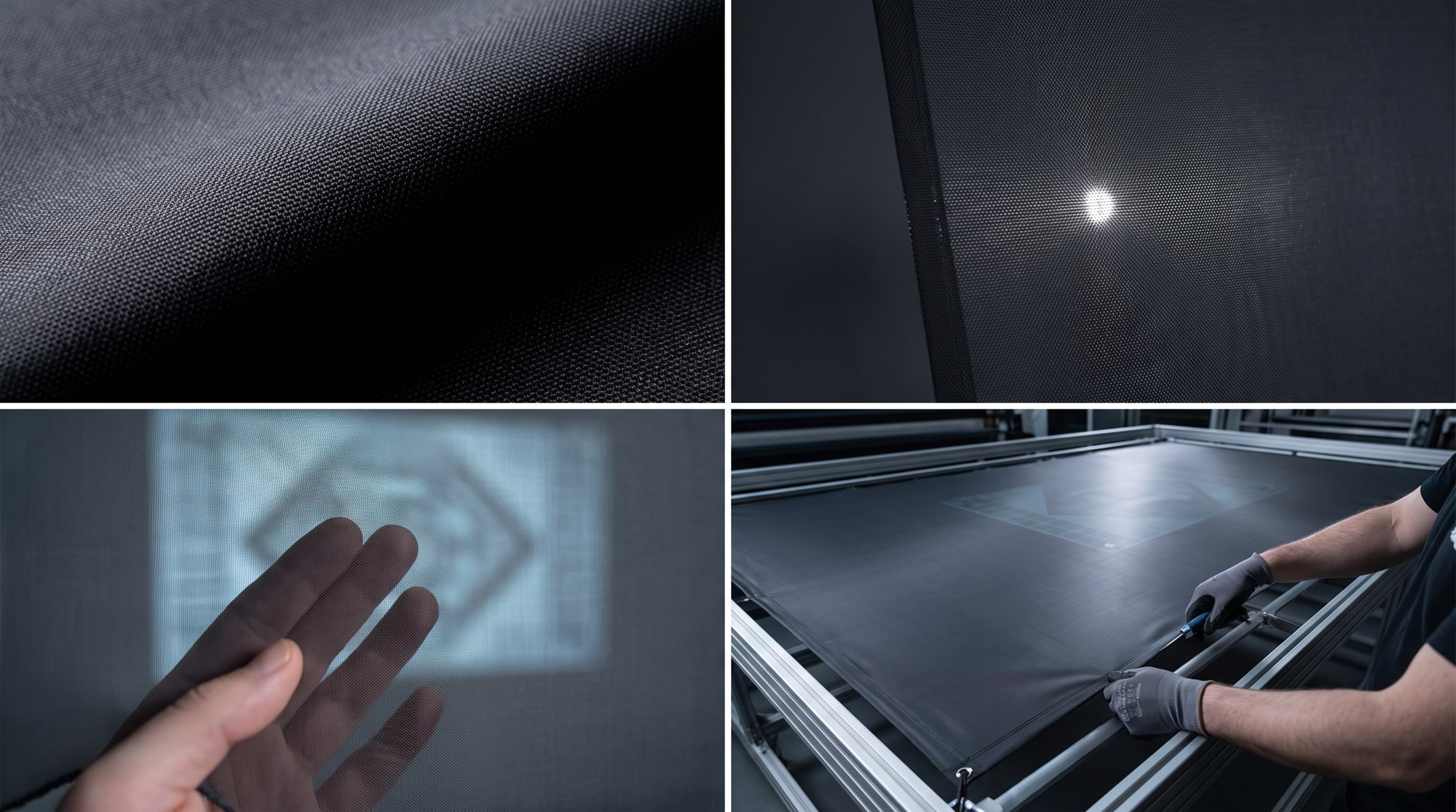
Everything in a projected environment ends at a surface. The most sophisticated system in the world produces nothing until its light meets a material, and what that material does with the light, how much it reflects and in which directions, what it lets through, what it absorbs, how it behaves when stage light or a performer's lamp falls on it, how it sounds, is the difference between a picture on a wall and a place.
This is why Qualia Forge's work on surfaces sits at the center of its creative practice rather than beside it. We have spent years developing and refining projection materials because the material is where the negotiation described in the first part of this piece is finally won or lost. Recall that the eye judges black not absolutely but relative to everything around it, and that a projector can add light but never remove it. The depth of a night sky, the possibility of a dark room that still contains a lit performer, the coexistence of a scene and the person standing in it: these are set by the surface before a single frame is shown.
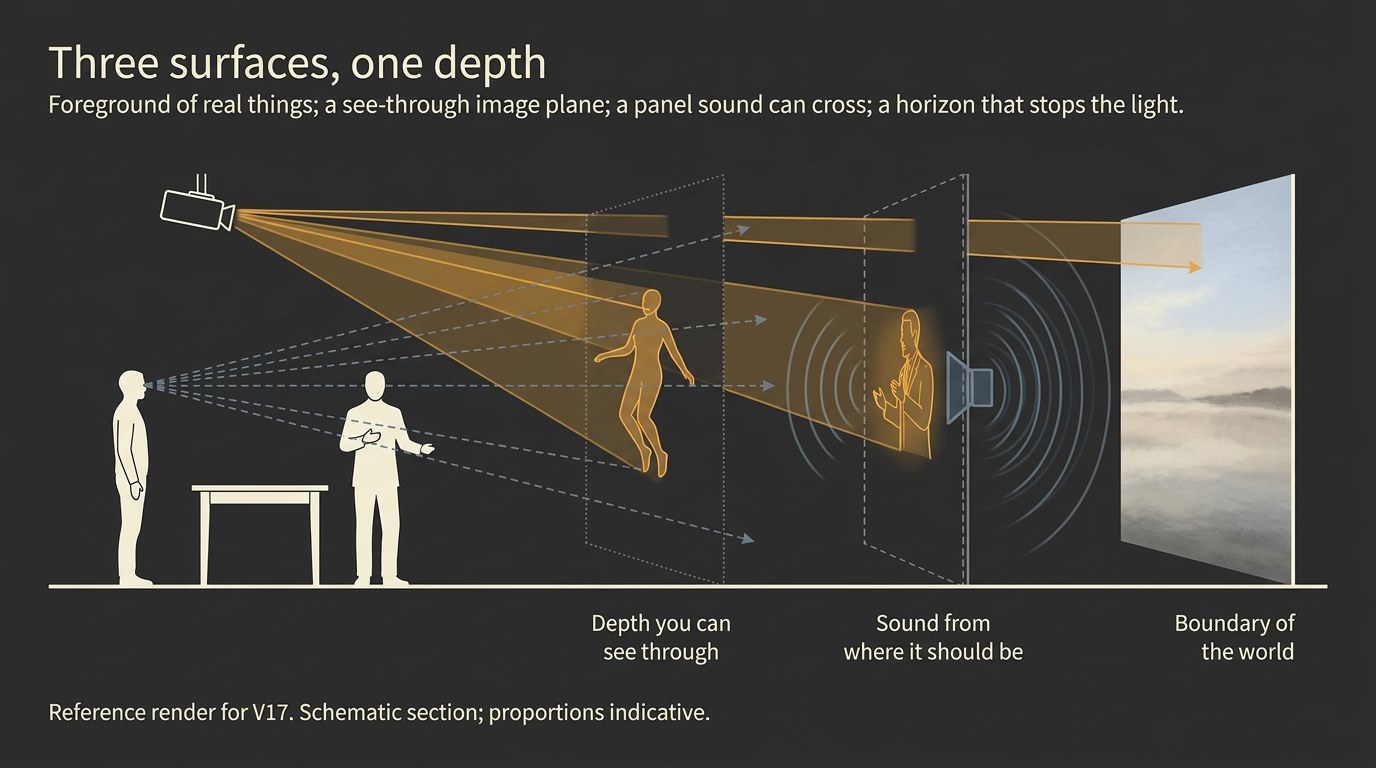
Three families of surface, and the ways they can be combined, give a composer of environments a vocabulary of depth.
Opaque surfaces: the boundary of the world
An opaque surface is the horizon. It defines the edge of the visible world and gives the periphery its enclosure. Its work is to hold a bright, deep image, to keep its darks dark in the presence of other light, and to do so evenly across a viewing area full of people standing in different places, since a surface that looks rich from the center and washed-out from the side has failed half the room. Curved and continuous, an opaque surface can remove the corners that remind the eye of a box and let a horizon run unbroken around a gathering. This is the surface on which a room becomes a coastline, a forest, a sky.
Acoustically transparent surfaces: sound from where it should be
We have seen how much of a place is heard rather than seen, and how precisely the ear places a voice. A voice that comes from a loudspeaker overhead while its face appears on a wall is a small contradiction the brain never quite forgives. An acoustically transparent surface allows sound to pass through the image, so that a loudspeaker can sit behind the very picture of the person speaking, and a footstep can come from the projected doorway rather than from the ceiling. It also allows acoustic treatment to live behind the image, so that a room can be visually seamless and acoustically composed at once. Image and sound arrive from the same direction, the negotiation settles, and a projected figure acquires a voice that belongs to it.
Transparent scrims: depth you can see through
The third family is the most magical and the most demanding. A transparent scrim is a surface fine enough that, unlit, it almost disappears, and yet it can hold a projected image. Hung partway into a room, it creates an image plane with real space visible beyond it. A figure can appear to stand in the air between a performer and the far wall. A landscape can be layered: a foreground of branches on the scrim, a distant valley on the opaque surface behind, and a real path between them for the audience to walk. Because the scrim reveals what is behind it, it adds the one thing a flat projection cannot: genuine physical depth that shifts correctly as the visitor moves. It rewards precise control of light, since anything that illuminates the scrim itself makes it visible, and that discipline is exactly what allows an image to float.
Composing with all three
The real possibilities appear when these surfaces are layered. An opaque horizon at the back of a room; an acoustically transparent panel where a character will speak; a scrim in the middle distance carrying weather or a memory; real objects and real people in front. Light passes through some layers and stops at others. Sound emerges from where the eye expects it. The visitor's moving body confirms the depth with every step. The room has become a space with foreground, middle ground and distance, all of them composable, and the story can move between them.
We do not think of a projection surface as a screen. We think of it as the boundary between the visitor and the world we are asking them to enter. Every property of the material is a decision about that boundary.
Technologies in Service of Perception
A shared environment is a whole instrument, and the surfaces are only one part of it. The other technologies matter for exactly the same reason: each one exists to satisfy a demand the body makes before it will agree to be somewhere. The interest is never in the equipment itself. It is in what the equipment lets people experience.
Image at the scale of a room
Projecting a single continuous world across the walls of a room asks a great deal of the systems that do it. Images from many sources must be aligned, blended and matched so that no seam reminds the periphery of an edge; content must be shaped to curved and layered surfaces so that a horizon reads as level from where people actually stand; the brightness and color of the whole must be held even as lamps age and rooms change. Modern projection mapping and calibration make this possible at a level of refinement that was unimaginable a decade ago. What it makes possible for a creative team is the thing the periphery has been waiting for: a world with no frame, in which the direction of a distant change can be composed as deliberately as a line of dialogue.
The same systems allow for a subtler art. Because the fovea and the periphery want different things, a room-scale image can be composed in two registers at once: a quiet, low-contrast surround that supplies weather and enclosure without demanding inspection, and the deliberate, well-lit, correctly scaled detail that draws the eye when the story needs it. The technology's job is to make that composition possible; the artist's job is to know where the eye should be.

Sound with a place
Spatial audio, the family of techniques by which sound can be given a precise and moving location in a room, is the acoustic answer to everything the second part of this piece described. With enough control, a footstep can cross the ceiling, a voice can approach from behind and settle beside a listener, and a piece of music can have geography. Combined with acoustically transparent surfaces, it lets sound come from where the eye says it should, and the brain, finding image and sound in agreement, stops noticing the machinery. Below the range of hearing, tactile transducers in floors, seats and rails can place a sound inside the body, so that a distant impact is felt in the soles of the feet before it is heard.
Air, temperature, scent
The least visible technologies may be the most affecting, because they reach the interoceptive channel that vision leaves untouched. A breath of moving air from the direction of a reveal; a slow cooling that begins before the image shows nightfall; a scent that arrives at the entrance and returns at the climax. These are difficult crafts, each with a timing of its own, and each rewards the lightest touch that carries the meaning. Their possibility is what allows an environment to be felt in the chest and on the skin and not only seen.
A room that listens
Sensing systems can let an environment know where people are, how many, how they have gathered, whether a hand has touched the rail. Used with care, this allows a room to respond: a horizon that brightens as a visitor approaches, a chord that sounds when a threshold is crossed, a story that waits until the group has assembled rather than running on a clock. The creative possibility is a place with something of a performer's tact, one that knows when the room is ready. The discipline is to remember that a position is not a feeling. A person can stand still because they are absorbed, or tired, or unsure. A good performer asks, waits and interprets cautiously. A responsive room should inherit that humility.
Real things
It would be easy to leave the oldest technology off this list. Physical objects, a real table, a lever that moves, a stone that is warm, a rail that trembles, remain the most persuasive elements in any composed environment, because they answer the body's testing hand directly. A single meaningful object, introduced at the right moment, can carry more attention than the most elaborate image in the room. The craft is to give the hand a few things worth touching, and to let those things change what the room shows.
The Forge: A Collective Way of Making
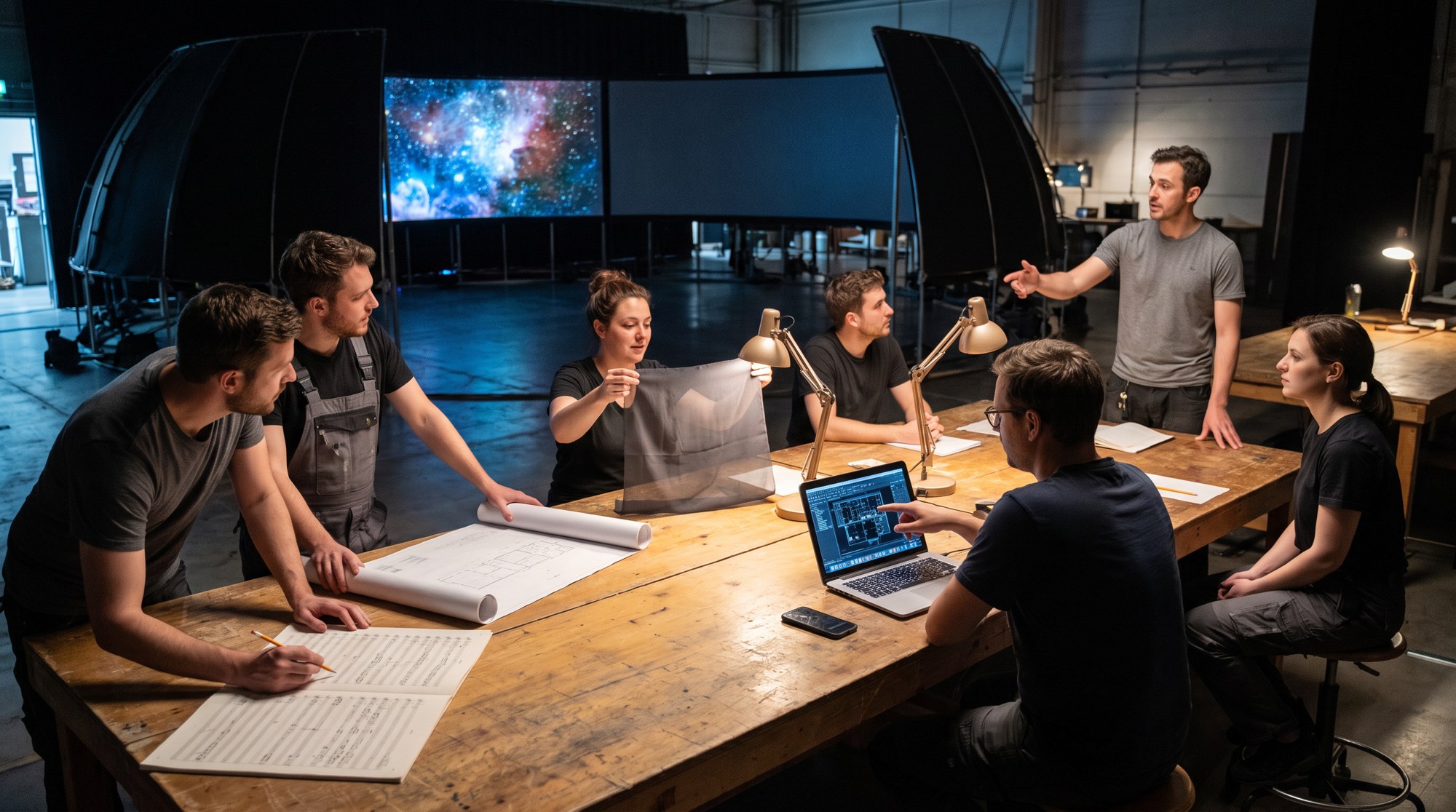
None of this can be made by one discipline. A writer needs to understand what a room can reveal and when. A technologist needs to know why the reveal matters, so that the system is built to protect it. A composer has to hear the ventilation. An architect has to imagine an audience hesitating at a doorway, and design the hesitation. A lighting designer must know what the scrim will do with a stray beam. A performer needs the freedom to notice the visitor who is struggling to keep up. A chef, if there is food, needs to understand what the drink at the end is for. Nobody's discipline ends neatly at the edge of their drawing.
The Forge is Qualia Forge's name for the way it works: a collective of artists, designers, engineers, performers, makers and thinkers who come together around a specific place to be made, and who work with the understanding that the experience belongs to no single craft. It is modelled less on a company and more on the workshops that have always produced complex made things, cathedrals, operas, films, where mastery of one craft is the entry ticket and respect for the others is the working condition.
Some of what the Forge does looks like research. Building a minute of an experience at full scale before building the rest, because a sightline failure that is invisible in a model appears only at human size. Inviting strangers into a prototype and asking them afterward, before any leading question, what happened. Testing a silence with the equipment running. Recording what an audience taught the team, so that the next environment begins where the last one ended.
Some of it looks like art. A composer deciding that a visual motif should hold still through a musical climax so that the music supplies the movement. A writer choosing to distribute a story across three listening positions so that no visitor needs all of them. A performer discovering that the strongest moment in an evening is the one in which the technology does the least.
And some of it looks like hospitality, because a shared environment is a place people are welcomed into, and how they are welcomed, oriented, invited, allowed to decline, and given somewhere to talk afterward is inseparable from what they will remember.
The Forge is where people who make different things learn to make one thing. Its only rule is that the visitor's experience is the drawing everyone is working on.
What Could Be Made Here
The instrument is only interesting for what can be played on it. Here are some of the things a shared environment makes possible, offered not as a catalogue but as a way of seeing what the form is for. Each is a different way of using the same body of knowledge this piece has described.
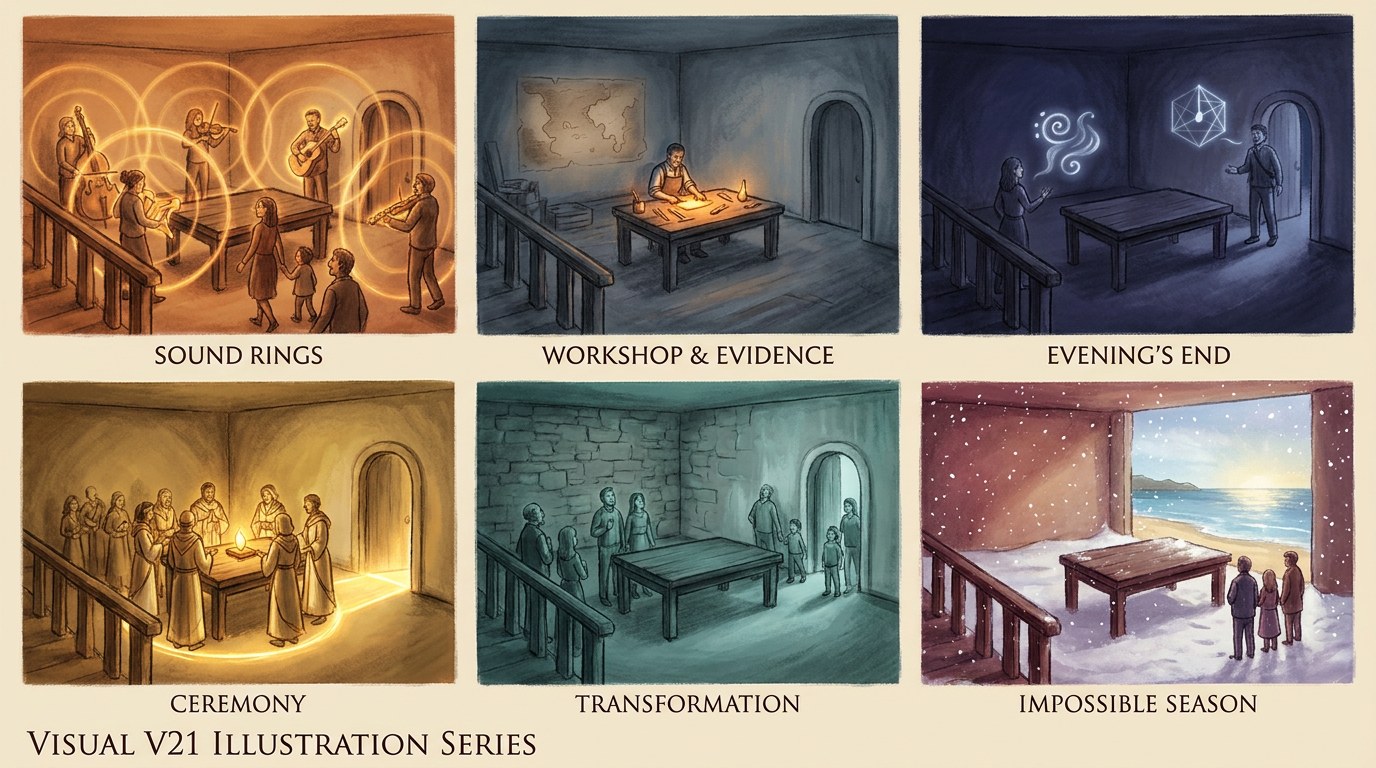
A concert you walk through
A composition written for a room rather than a stage, in which each instrumental voice has a location, the audience is free to move among them, and the walls carry a slow visual argument that answers the music's structure rather than illustrating it. Visitors would discover that the piece sounds different from every position, that a chord exists only where three musicians' sound overlaps, and that moving is a way of listening. Musicians would be visible, breathing and adjusting together; the audience's own movement would become part of the mix.
A story assembled from evidence
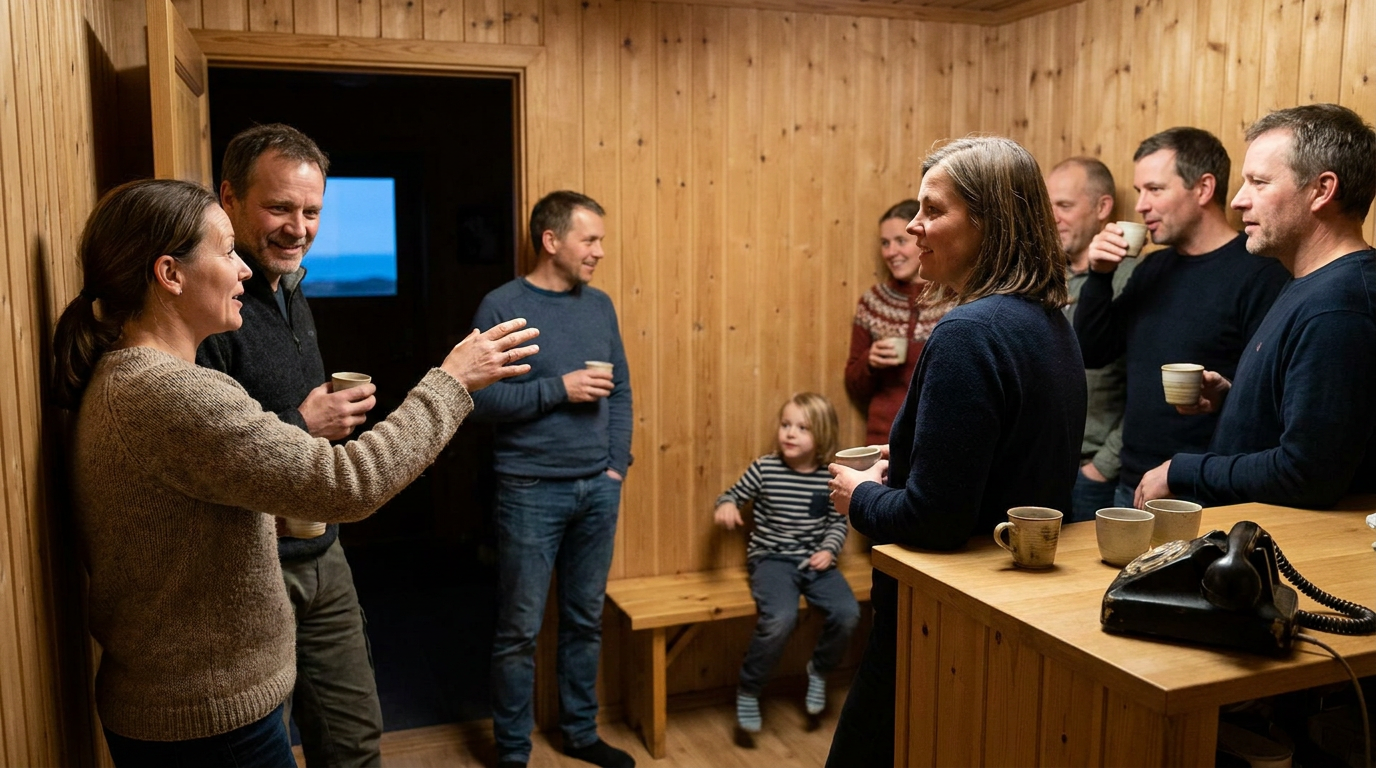
An environment entered after something has happened. Real objects, a message half-written, tools still warm, a receiver with a worn handle, and a performer who is trying to understand what the visitors are also trying to understand. The story would live in three or four places in the room, each offering a fragment, none required. Visitors would piece it together, differently, and complete it in conversation afterward over something warm. The climax would give the technology less to do and the performer's face more.
A landscape that remembers you
A place that builds its own vocabulary during a visit: a quality of light attached to the first encounter with a character, a scent at the threshold, a chord when a door opens, and then returns each of them, transformed, at the end. Visitors would leave with the feeling that the room had learned them, because they had learned the room.
A ceremony for a gathering
Not every shared environment needs a plot. Some of the most powerful human experiences are ceremonies: gatherings organized around a threshold, a rhythm, a shared object and a change of state. A room built for this could hold a graduation, a memorial, a launch, a homecoming, a wedding, and give it what ceremonies have always sought: a place that seems to have been waiting for exactly these people, a scale that dignifies the moment, and a way of ending that lets it settle.
An idea made into a place
Organizations have ideas about themselves that a presentation cannot carry: the transformation of a material, the shape of a decade of research, the difference a product makes in a life. A shared environment can let people stand inside such an idea rather than be told it. A manufacturing story told through a room that slowly changes its own material. A research story that lets visitors examine a question from several physical positions and find that each position shows them something different. A reveal built around the relationship between anticipation and the object revealed, rather than around brightness.
A place that does not exist
And sometimes, simply, an artist arrives with somewhere that has never been: a coastline from a dream, a city seen once, a season that lasts an hour. The instrument exists so that such a place can be built, at the scale of a body, with weather and sound and a floor, and so that people can go there together and come back with the memory of having been.
An Invitation
This piece began with a door opening and a room you had never seen. We have walked a long way since then: through the eye and the ear and the inner organ of gravity, through the map in the hippocampus and the wave of attention moving through a crowd, through imagination, association, music, performance and story. Everything on that walk points to one conclusion. A person's experience of being somewhere is one of the most intricate things the mind does, and it can be composed for, with knowledge and with care, at the scale of a room, for people who are together.
That is what Qualia Forge exists to make possible. We build the surfaces where light becomes world. We develop and integrate the technologies that let sound have a place, that let a room breathe and respond, that let image run past the edge of the eye. And we hold together the collective practice, the Forge, in which the different crafts required to compose an experience learn to work on one drawing. We do not do this alone, and we would not want to. The instrument exists to be played.
If you are an artist, a composer, a writer, a choreographer or a director with a world that needs a room around it, we would like to hear about it. If you are an architect, a lighting or sound designer, an engineer, a maker or a technologist who has wondered what your craft could do in company with the others, the Forge is built for you. If you are an organization with an idea that a presentation cannot carry, or a gathering that deserves a place of its own, we would like to help you find out what it could become when people can stand inside it.
The visitor, when they finally arrive, will enter with a life we do not know. They will notice some things and miss others, bring their own associations, and perhaps turn to the person beside them at a moment none of us scripted. The work should be exact enough to hold that encounter and open enough to let it belong to them.
That is the art of being somewhere. Come and make it with us.
Read from the beginning: Part I · How we experience reality · Part II · How we experience place · Part III · How experience becomes meaningful. Or write to us directly: info@qualia-forge.com