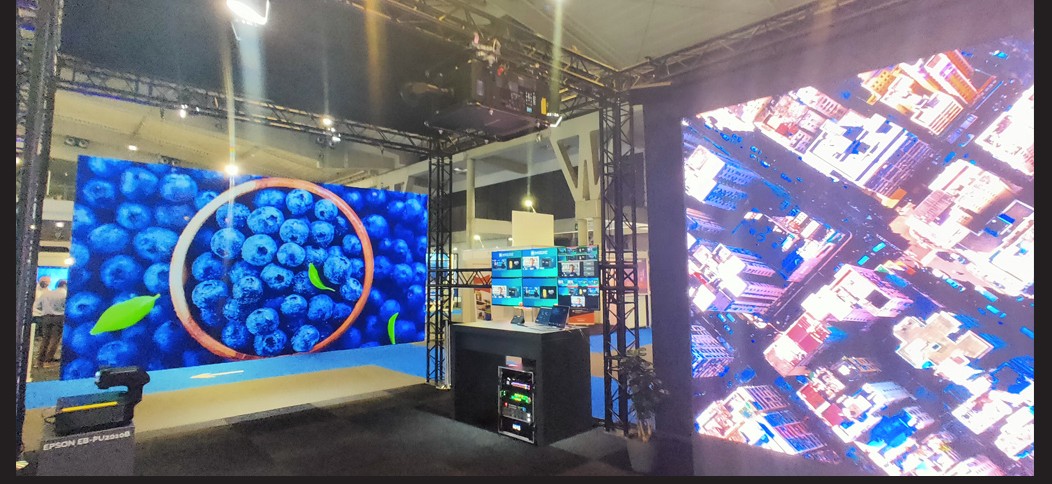
Gray screens buy contrast by rejecting light at an angle, and pay for it in seats. The surface absorbs the room at the material level instead, so the image survives everywhere.
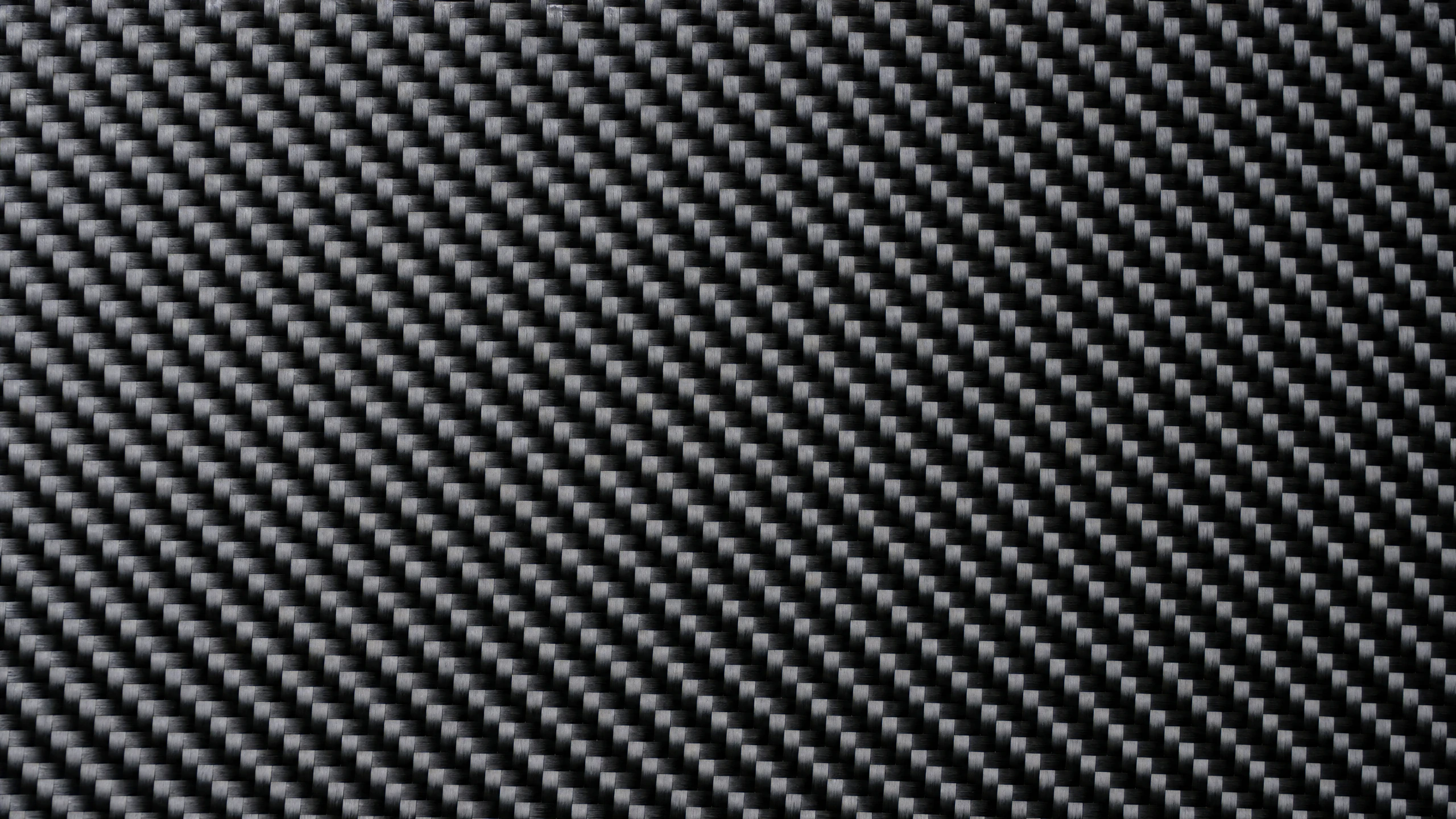
This is the surface working. Between frames the weave sits matte and black, dissipating ambient light inside the fiber structure; when the projector’s light arrives, the image returns at full color. What happens here at the scale of single fibers is what an audience sees at ninety feet: black held by the material, color returned by the projection.
The mechanism has no moving parts and no power: it is the weave itself choosing what to absorb and what to return. It works the same at the micro level and across an arena-scale image.
The surface is built on carbon-based fiber technology: a matte, light-trapping weave engineered to swallow ambient light instead of returning it. The same discipline extends to the hardware: an ultra-light carbon-fiber fast-fold frame that packs into road cases and deploys in minutes.
The surface is passive, so the projector is the only thing in the system drawing power. It makes no heat, needs no cooling, and carries a DIN 4102-1 Class B1 / NFPA 701 fire rating.
Ambient light enters the fiber structure and dissipates inside the weave rather than reflecting back toward the audience as gain. The surface sets the black level, whatever the venue is doing.
One piece up to 39 feet (11.9 m) high and 300 feet (91 m) wide, with no tiles, no seams, no pixel grid. Formable to curves, domes, and complex geometry.
Fast-fold, ultra-light, road-case portable. An arena-scale image rigs in minutes.
Two solid builds. The opaque surface is a micro-weave multi composite textile with a resin-coated back, 0.44 mm thick, that stretches a few per cent so it can be tensioned into a shape. The acoustically transparent surface is bath coated then resin coated on one side, 0.225 mm thick and roughly six times stiffer, so it holds a flat plane and passes sound. Both are rollable, washable, cold cut to shape and flame retardant in the material rather than treated on the surface. The Transparent Scrim is a different animal: a 32 point hexagonal mesh at 41.2 g/m², front or rear projected, and gone on a lighting cue.
Figures are for the surface alone: reinforced edges, attachment systems, frame hardware and packaging are specified and weighed on top. Supplied for guidance, based on average results from current production, and not a warranty. Made and finished in the USA.

At least 85% of peak brightness across the full ±90° hemisphere, with no half-gain point. The front row, the far aisle, and the steep side seat all see the same image. This is also why the range carries no gain value: gain measures light pushed back toward the center seat and taken away from the sides, and nothing here is redistributed that way. For the output in your own venue, use the visualizer.
Returns the projector’s laser primaries to within ±1%, supporting wide-gamut delivery including Rec. 2020 and DCI-P3. Red stays red, on every seat and every frame.
No pixel pitch and no refresh cycle, so no moiré, no refresh beat, no rolling-shutter interaction. The result reads as an organic, cinematic image rather than harsh emissive light.
One seamless piece up to 39 feet (11.9 m) high and 300 feet (91 m) wide; beyond that height, engineered seams make the scale essentially unlimited. Formable across flat, curved, domed, and complex geometry, where flat tiles struggle to follow a curve.
An ultra-light carbon-fiber fast-fold frame packs into road cases and deploys in minutes. The surface draws no power and makes no heat. The projector is the only powered element in the system.
The Acoustically Transparent family is woven to let sound pass while staying opaque to the image, so loudspeakers can sit behind the picture in the same plane. Low insertion loss: about 1.3 to 1.5 dB broadband in the tested configuration, about 1.2 dB through the principal dialogue range, and a gradual high-frequency reduction that is readily corrected in normal calibration. The measurement →
Universal to the technology. Contrast, gamut, color accuracy and acoustic figures are measured in an independent optical laboratory and issued per surface. Gain is not among them: these surfaces do not trade angle for on-axis brightness, so there is no gain value to state. In industry terms this is an ambient-light-rejecting (ALR) screen; it earns the name by absorption rather than angular rejection, so there is no viewing cone to sit inside.
How the three ways to build a very large image compare: flat-panel LCD, the Qualia Forge projection surface, and direct-view LED.
The surface holds strong contrast under ambient light with an accurate color spectrum and less glare than LED, at a lower overall brightness. It is the deep, cinematic image the most demanding work is after.
The go-to under high ambient light, but with trade-offs. At large scale it is effectively Full-HD, carries a high cost, and brings a real risk of periodic maintenance: pixel defects and panel non-uniformity.
A projection alternative for images over 100 inches: FHD and 4K, affordable to own and run, and highly durable. It holds deep black and true color under the lights, with none of the seams, moiré, or per-panel upkeep of a tiled wall.