The Art of
Being Somewhere.
Why Qualia Forge exists, and what it makes possible. This is our thesis, written to be read straight through or entered at any chapter, and it moves in four parts: this one on how we experience reality at all, then how experiences assemble into the feeling of a place, how a place becomes meaningful, and what all of that makes possible when a room is built to be an instrument for it.
Before Anything Happens
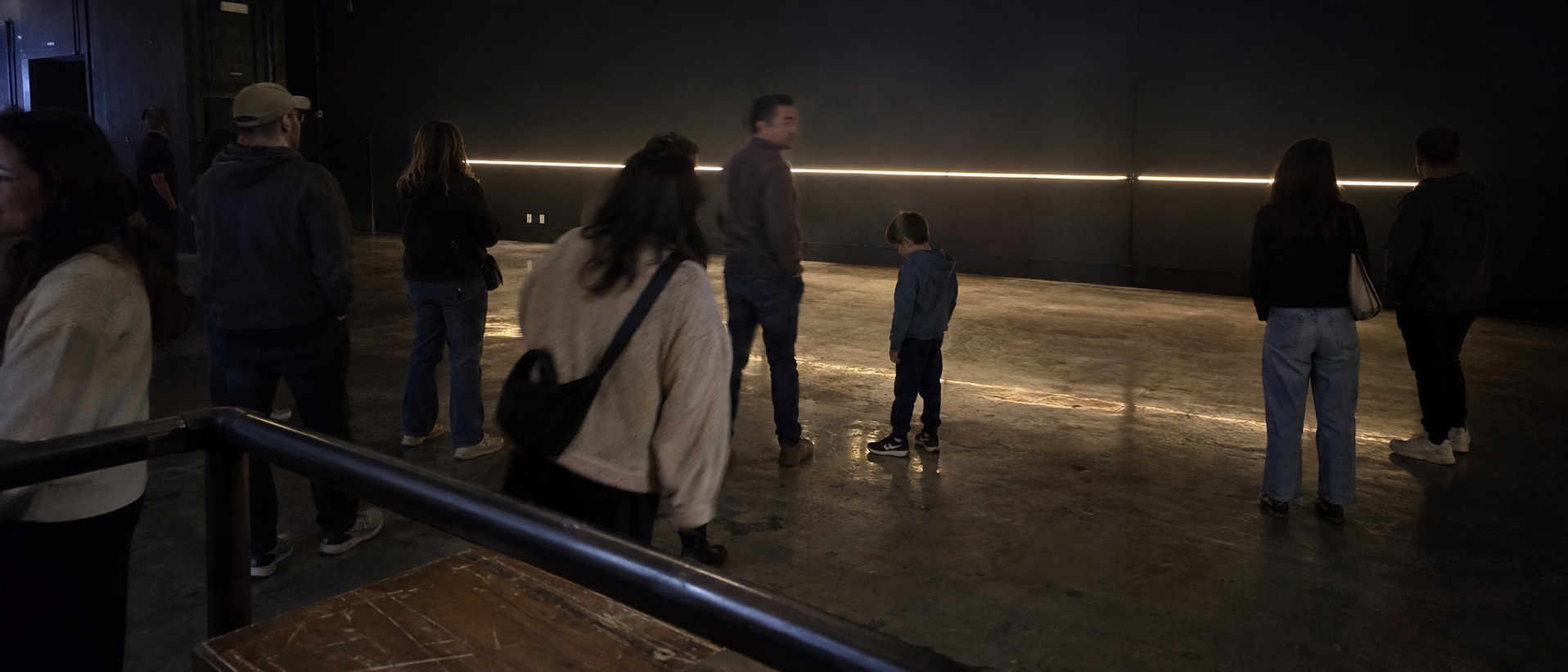
Someone opens a door and you follow them into a room you have never seen. Other people are already inside: a couple talking quietly, a woman standing apart, a child studying the floor. Without deciding to, you take in the distance to the far wall, the temperature of the light, the direction of a voice. You have not chosen where to stand yet, and you already understand something about this place.
Then a line of light appears where the wall used to end. A sound arrives from beyond it. The woman turns, and you turn too. What was a wall now reads as a distance. The floor is still under your feet, but the room has acquired another scale, and you are aware at once of the child beside you and of something very large ahead. A story has begun before anyone has explained it.
Everything Qualia Forge does begins with a fascination for that moment: the instant when a physical space, some light, some sound and a handful of other people combine into an experience that feels like being somewhere. We build the surfaces, the technologies and the collaborative practice that let that moment be composed deliberately, at architectural scale, for people who are physically together.
But the technology is the last thing to understand. To see why any of it matters, you have to start much earlier, with the body, with what light and sound and air actually do when they meet a person, and with the extraordinary work the mind performs to turn those encounters into a world. This piece is an invitation to take that walk with us. It moves in four parts: how we experience reality at all; how those experiences assemble into the feeling of a place; how a place becomes meaningful through imagination, music, performance and story; and finally what all of that makes possible when a room is built to be an instrument for it.
We have written it for anyone who is curious, and especially for the artists, designers, engineers, performers and clients who might one day help bring one of these environments into being. You do not need a background in neuroscience or optics. You only need to have stood in a room once and felt it change.
The name Qualia Forge joins two words on purpose. Qualia is the philosopher's term for the felt quality of experience: what it is like to see this red, to hear that voice, to stand in this light. A forge is where raw material is worked, with heat and skill, into something that holds its shape. We make places where experience is the material.
Nothing reaches the mind directly. Light, pressure waves, molecules and contact meet the body at its sensory surfaces, and the nervous system builds, from those encounters, the only world any of us has ever known. Understanding how that construction works is the beginning of knowing how to design for it.
The World Does Not Arrive. It Is Made.
Hold a warm cup between your hands. The physics is simple enough: heat flows from ceramic to skin, receptors in the fingertips register the change, signals climb the arm. But none of that is what you experience. What you experience is warmth, a particular, comfortable, faintly domestic warmth, with a quality that belongs to you and to this moment. The physics can be measured. The warmth has to be lived.
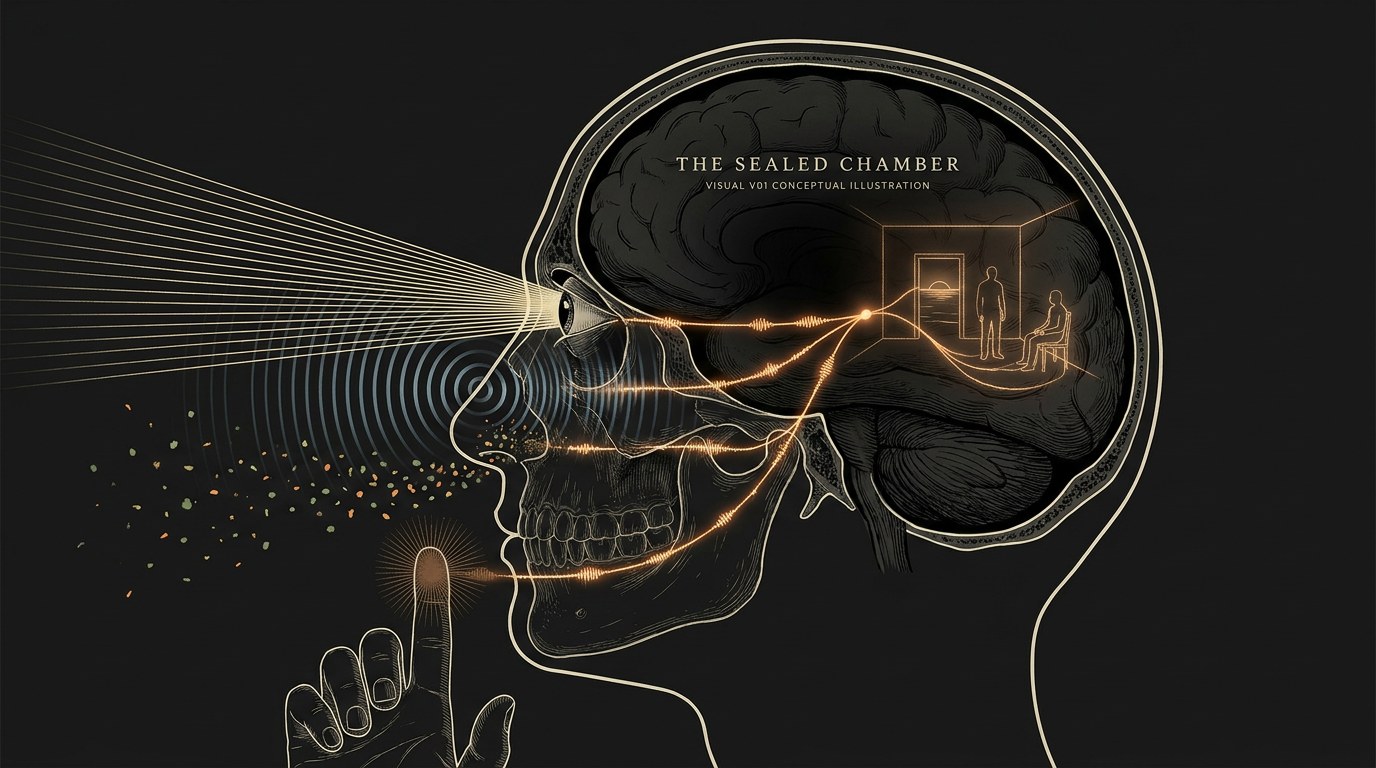
Philosophy has a word for that lived quality: qualia. The redness of red, the sharpness of lemon, the sound of a familiar voice heard unexpectedly in a crowd. Qualia are what an experience is like from the inside, and they are the strangest fact about being a person. Everything you have ever seen, heard or touched has taken place in the dark, inside a skull, assembled by tissue that has never itself been exposed to light. The brain sits in a sealed chamber, cushioned in fluid, and yet it has produced every sunset you remember.
This is not a mystical claim. It is anatomy. There is no small window in the head through which a person looks out. Instead, a photon strikes a molecule in the retina and changes its shape. A pressure wave bends a hair cell in the inner ear. An odorant molecule locks into a receptor high in the nasal cavity. Each of these events is converted, at the body's edge, into the one currency the nervous system trades in: patterns of electrical and chemical signaling. From that point on, the world as such is gone. What continues inward is a description of it.
And the description is not passive. For most of the twentieth century, perception was pictured as a pipeline: sensation flows in, the brain processes it, and a finished image pops out at the far end. The current picture, supported by decades of physiological and behavioral work, is closer to the opposite. The brain is a prediction engine. It constantly generates expectations about what the senses are about to report, compares those expectations against the actual signals, and uses the mismatches to correct itself. Perception is the brain's best current guess, continuously revised. You do not see the room. You see your model of the room, checked against the light.
This is why a good magician can make a coin vanish in plain sight, why a projected shadow moving on its own can raise the hair on your arms, and why the same piece of music can be unbearable in one context and transcendent in another. The model is doing enormous work, and it can be led.
Perception is not a window. It is a negotiation, conducted at speed, between what the body reports and what the mind expects. Everything we build at Qualia Forge is designed for that negotiation.
None of this means the world is arbitrary or that an audience will believe anything if the stimulation is elaborate enough. The body is a skeptic. It checks each invitation against every other channel of evidence. A projected staircase meets a flat floor underfoot. A distant forest arrives with the reverberation of a concrete room. The negotiation is honest, and it is precisely because it is honest that getting it right is so powerful. When light, sound, air and the physical structure of a room agree with one another, the model settles, and a person simply finds themselves somewhere.
Light Finds an Eye
Before an image is a landscape, it is light distributed across a space. Everything we see begins as electromagnetic radiation, a wave that is also a stream of particles, spread across a spectrum so wide that the human eye responds to less than one part in a trillion of it. Radio waves are meters long. Gamma rays are smaller than an atomic nucleus. Between them, in a sliver from roughly 380 to 750 nanometers, lies everything we have ever called color.
That sliver is not an accident. It is the band of wavelengths that pass most easily through water and through the atmosphere, the light that reached the surface of a young ocean and shaped the first photoreceptors. We see the light we evolved in. A projected sunset does not need to reproduce the physics of a real one to convince; it needs only to reproduce the pattern of stimulation at the eye, and the eye will do the rest.
The instrument
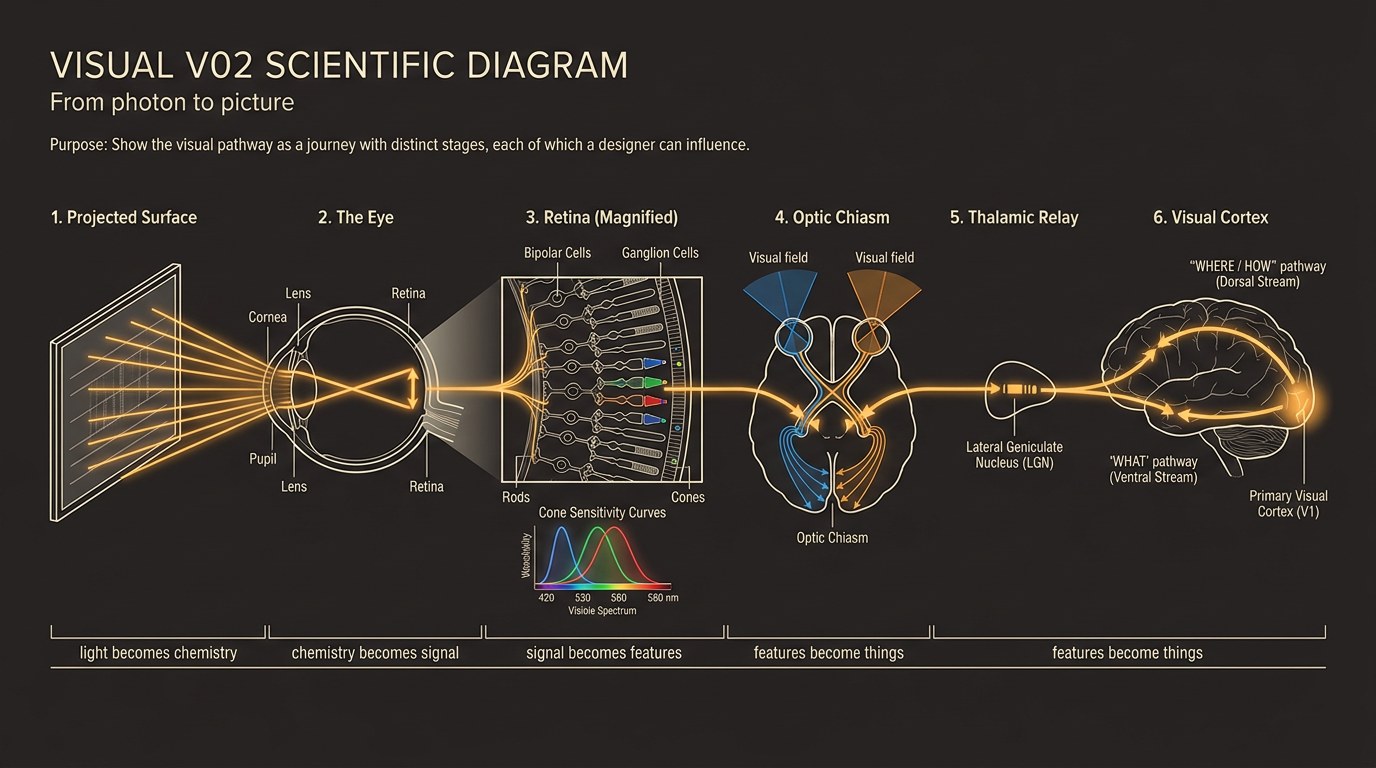
Light enters through the cornea, a transparent dome that does most of the focusing, and then through the pupil, whose diameter the iris adjusts by a factor of roughly sixteen in area between bright sun and deep dark. The lens behind it fine-tunes the focus, and an inverted image lands on the retina at the back of the eye.
The retina is not a screen. It is brain tissue, a sheet of neurons that migrated outward during embryonic development, and it begins processing the image before a single signal leaves the eye. Around 120 million rod cells handle dim light and motion. Around six million cone cells, concentrated at the center, handle detail and color. Three kinds of cone, tuned to overlapping bands of short, medium and long wavelengths, are all the hardware there is for color. Every hue you have ever seen is a ratio, a comparison the brain makes between how strongly those three populations are responding. Yellow is not a wavelength you detect; it is a particular agreement between your red-sensitive and green-sensitive cones, which is why a screen with only red, green and blue can show you a yellow that does not physically exist in its light.
Signals leave the eye along about a million fibers in the optic nerve, cross partially at the optic chiasm so that each half of the brain receives the opposite half of the visual field, pause at a relay station in the thalamus, and arrive at the primary visual cortex at the very back of the head. There the image is taken apart. Edges, orientations, motion and color are analyzed in separate populations of cells and reassembled along two great pathways: one running toward the top of the brain that answers where things are and how to move among them, and one running toward the temples that answers what things are. A face, a word, a tool, a landscape: each has regions that respond to it with a specificity that still astonishes the researchers who map them.
The eye does not treat the whole wall equally
One consequence of this architecture matters more than any other to the design of large environments. Detail is not spread evenly across your field of view. The fovea, a pit in the center of the retina that covers a patch of the world about the size of your thumbnail held at arm's length, contains the densest packing of cones and produces almost all of your sharp vision. Move two degrees away from it and acuity has already halved. At the edges of vision you cannot read a word or identify a face, but you are exquisitely sensitive to motion and to changes in brightness.
So vision is a hand-off. The periphery detects; the fovea inspects. Your eyes make three or four rapid jumps every second, each landing the fovea on whatever the periphery has flagged, and your brain stitches these glimpses into the seamless scene you believe you are seeing all at once. You are not. You are seeing a series of postage stamps and a very confident prediction of the rest.
For anyone composing an image the size of a room, this changes everything. A panoramic environment is not a very large screen; it is two different images living together. One is the image of the world, which speaks to the periphery: horizon, weather, scale, the sense of enclosure or openness, the direction from which change is coming. The other is the image of the story, which must be brought to the fovea: a face, a gesture, an object, a word. Movement at the edge of the room is not decoration. It is the invitation that moves the fovea. A face that needs to be read has to be large enough, lit enough and still enough to be found. If every surface asks for close inspection at once, the production has set up a competition no visitor can win.
Darkness is a material
A projector adds light. It cannot take light away. Everything that already falls on a surface, from exit signs to a performer's lamp to light bouncing back from the opposite wall and the floor, becomes the floor beneath which the image cannot go dark. A night sky in a room with a raised black level is not a night sky. It is a grey wall with stars on it, and the eye knows.
The eye also adapts. Give it ten minutes in a dim room and its sensitivity increases by a factor of thousands as the rods recover their photopigment. Give it a single bright flash and that adaptation is gone. So darkness in an environment is not a setting; it is a resource that has to be protected, spent carefully and rebuilt. The way a room enters darkness, holds it and releases it is part of the composition, and it depends as much on the material of the walls as on the equipment throwing light at them. We will come back to this, because it is one of the places where Qualia Forge's materials work and its creative ambitions turn out to be the same thing.
Color is not on the wall
A final, humbling fact. The color you see is not a property of the light reaching your eye. It is the brain's estimate of the surface that reflected that light, after discounting the illumination. A white sheet looks white under noon sun, under a tungsten lamp and under a blue evening sky, though the light it sends to your eye differs enormously in each case. This is color constancy, and it means the same projected image will read differently depending on what else the room is telling the eye about its light. A saturated scene that looks handsome on a monitor must be judged on the real material, at the real scale, under the real spill, because the eye will judge it in relation to everything around it. The wall is never seen alone.
Sound Gives the Room a Shape
Close your eyes in an unfamiliar room and you still know a great deal about it. You can hear whether the ceiling is high, whether the walls are hard or soft, roughly how far away the person speaking is standing, and, if a door opens behind you, exactly where. Vision tells you what things are. Hearing tells you where you are, and it does so continuously, in every direction, in the dark.
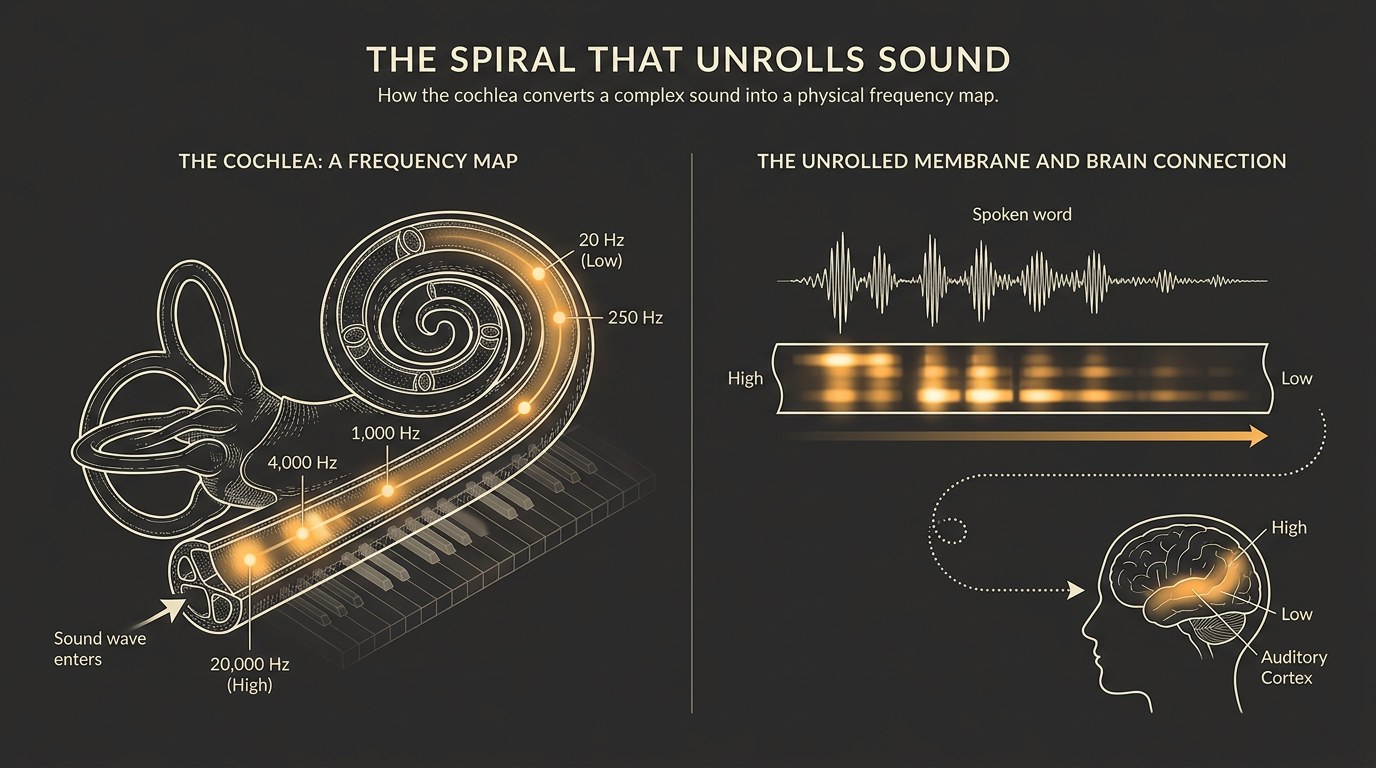
Sound is pressure. A vibrating object pushes and pulls the air around it, and those compressions and rarefactions spread outward at roughly 343 meters a second, about a meter every three milliseconds. The outer ear, with its folds and ridges, gathers this pressure and filters it in a way that depends on where the sound is coming from. The ear canal funnels it to the eardrum, a membrane thinner than paper, which vibrates in sympathy. Three tiny bones amplify the motion by a factor of about twenty and deliver it to the cochlea, a fluid-filled spiral the size of a pea.
Inside the cochlea a ribbon of tissue, the basilar membrane, runs the length of the spiral, stiff and narrow at the entrance and loose and wide at the far end. High frequencies make it vibrate near the entrance; low frequencies travel farther in. Along its length sit about 3,500 inner hair cells, each crowned with bristles so fine that a deflection the width of an atom can open ion channels and trigger a signal. The cochlea is, in effect, a mechanical spectrum analyzer, unrolling a sound into its component pitches and laying them out along a physical map. That map is preserved all the way to the auditory cortex, where neighboring cells respond to neighboring frequencies. Pitch, in the brain, has a place.
How the ear finds a place
Locating a sound is a feat of timing. A sound from your right reaches your right ear a fraction of a millisecond before it reaches your left, and slightly louder, because your head casts an acoustic shadow. The brainstem compares the arrival times at the two ears with a precision of about ten microseconds, finer than any single neuron can fire, by using arrays of cells that detect coincidences. From that comparison, and from the way the outer ear's folds color a sound differently depending on its elevation, the brain places the source in space. It is fast, unconscious and remarkably good; a listener can often distinguish two sources only a degree or two apart directly ahead.
Then there is the room itself. A voice in a hall reaches you first directly, then, milliseconds later, as a cascade of reflections from walls, floor and ceiling, and finally as a diffuse wash of reverberation that decays over a second or more. The brain does something clever with this. It fuses the early reflections with the direct sound, so you hear one voice rather than a hundred echoes, and it reads the pattern of decay as information about the space. A long, smooth decay says cathedral. A short, dead decay says closet. A voice with no reverberation at all says: this person is very close to you, or you are wearing headphones. Reverberation is how a room tells you its size before you have looked.
This is why sound carries so much of the space an image leaves unstated, and why a projected forest in an untreated concrete room can feel like a photograph of a forest rather than a forest. The eye is being told one thing about distance and the ear another. The negotiation fails, and the model does not settle.
Sound you feel
Below about 20 hertz, pressure variations stop being heard and start being felt, in the chest, the stomach, the soles of the feet. Even well above that threshold, low frequencies at high level are as much a bodily experience as an auditory one. A bass note is not heard from a distance; it happens inside you. Add to this the fact that the whole body is a vibration sensor, from the deep-pressure receptors in the skin to the stretch receptors in muscle, and it becomes clear that sound has a tactile life. A floor that hums, a rail that trembles as a distant machine starts, a seat that carries a heartbeat: these are ways of placing an event inside the visitor rather than in front of them.
The other half of sound
Silence has to be produced. When the soundtrack stops, the room is still full of sound: ventilation, the fans of projectors, the hum of amplifiers, the breathing and shuffling of the people present. A composed silence is one in which the equipment has been quieted enough that what remains is the audience hearing itself. There are few more powerful moments in a shared environment than the one in which forty people realize, together, that the only sound left in the room is them.
The Body Is Not a Spectator
A hand finds a rail in the dark. In that single contact it receives temperature, texture, position and resistance all at once. The image around it may describe the deck of a ship, but it is the rail that tells the body it is standing on something, and it is the rail the body will trust.
We tend to think of the senses as five, and of touch as the least of them. In fact touch is a family of senses, spread through every square centimeter of skin and deep into the muscles and joints, and it does more than any other to tell us that we are here. Four kinds of mechanoreceptor in the skin respond to light touch, sustained pressure, fine texture and vibration. Thermoreceptors track heat and cold as changes rather than absolutes, which is why a lukewarm bath feels hot to a cold hand. Nociceptors watch for damage. All of this is mapped, in the somatosensory cortex, onto a distorted portrait of the body in which the lips and fingertips are enormous and the back is tiny, a map drawn not by size but by sensitivity.
Beneath the skin lies a sense we rarely name. Proprioception is the body's knowledge of itself: stretch receptors in muscle and tendon, and pressure sensors in the joints, report continuously on where every limb is and how it is moving. Close your eyes and touch your nose; proprioception is what makes that possible. It is the sense that lets a visitor cross a dark room without looking at their feet, and it is the sense that tells them, whatever the walls are showing, that they have not moved.
The organ of gravity
Deeper still, inside the temporal bone beside the cochlea, sits the vestibular system: three fluid-filled semicircular canals arranged at right angles, which detect rotation of the head, and two small chambers lined with crystals resting on hair cells, which detect linear acceleration and, always, the pull of gravity. This is the sense of balance, and it is the sense that most stubbornly refuses to be fooled.
When the visual system reports motion and the vestibular system reports stillness, the result is a conflict the body takes very seriously. This is the mechanism of motion sickness and of its milder cousin, the sway you feel when a large image begins to move around you. It is also the mechanism behind one of the oldest illusions in immersive design: vection, the compelling sense that you are moving when only the scenery is. Vection is a gift when it is wanted and a liability when it is not, and the difference lies in whether the body has been given something stable to hold on to. A floor that stays still, a rail that stays put, a stationary reference somewhere in view: these are not concessions to comfort. They are the anchors that let the rest of the room move.
The body is the audience's instrument for testing the truth of a place. Give it something solid, and it will lend its confidence to everything else.
Interoception: the weather inside
There is one more sense, and it may be the one that matters most to how an experience is remembered. Interoception is the perception of the body's own internal state: heart rate, breathing, temperature, the tightness of the stomach, the loosening of the shoulders. It is carried by nerves from every organ to a region of cortex called the insula, and it is the physical substrate of what we call feeling. Anxiety is a fast heart and shallow breath before it is a thought. Calm is a long exhale. When a room changes temperature by a degree, when a breeze arrives from an unexpected side, when a low sound tightens the chest, the visitor's interoceptive sense registers it before their conscious mind has found an explanation, and that unexplained bodily shift becomes the emotional coloring of whatever they see next. Designers who work only for the eye leave this entire channel silent.

The Air Remembers
An unfamiliar room can become unexpectedly personal when it contains a familiar smell. The association arrives before you have found a name for it: a grandmother's kitchen, a school corridor, a particular summer. Smell is the sense that most reliably brings the past into the present without asking permission.
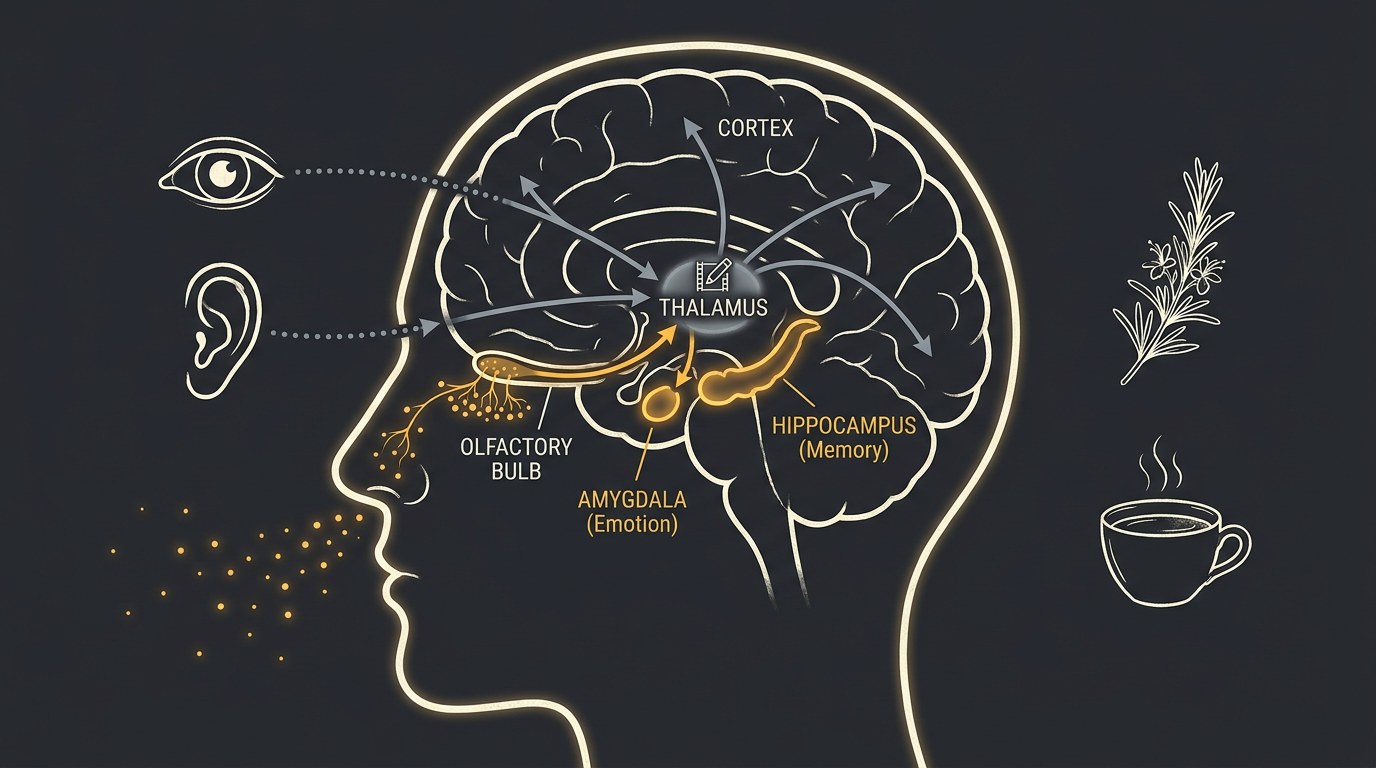
The anatomy explains why. Olfactory sensory neurons sit in a patch of tissue high in the nasal cavity, and they are the only neurons in the body that are exposed directly to the outside world. Humans have roughly four hundred kinds of odorant receptor, and because each odor molecule activates a combination of them, that modest set can distinguish an almost unlimited range of smells. The signals travel a very short distance to the olfactory bulb, and from there, uniquely among the senses, they pass straight into the limbic system, the amygdala, which handles emotion, and the entorhinal cortex and hippocampus, which handle memory, without first stopping at the thalamus, the relay station every other sense must pass through. Sight and sound are edited before they reach feeling. Smell is not.
This is the physiological basis of what novelists have known for centuries: that a scent can unlock a decade. It is also why smell is the hardest material to author for a room full of strangers. The associations it triggers are built by each person's history. A forest scent that means childhood to one visitor means floor cleaner to the next. The lesson is not to avoid scent but to use it the way a composer uses a motif: introduce it in the experience, attach it to a moment or a character, and then let it return. The production builds the association itself rather than borrowing one it cannot control.
Scent also has a timeline. It has an onset, a distribution through the air of a room, a clearance, and, in the nose, a rapid adaptation that makes any continuous smell fade from awareness within minutes. The unit of design is not the smell but the whole arc: arrival, recognition, disappearance and, perhaps, return.
Taste, and the table
Taste is the narrowest of the senses, five or six basic qualities detected by receptors across the tongue and palate, and flavor is one of the broadest, because flavor is not taste. It is taste fused with smell that reaches the nose from the back of the mouth, with texture, temperature, sound and expectation. Experiments have shown that changing the crunch a person hears while eating changes how fresh they judge the food to be; that the color of a drink changes the flavor people report; that the weight of a spoon changes how rich a dessert seems. Flavor is constructed, like everything else, from a negotiation among the senses.
What makes food extraordinary in a shared environment is not only what it does to the tongue. It is what it does to the social situation. Accepting a cup, waiting while someone else is served, sitting at a table with strangers: these acts have their own pace and their own etiquette, and they slow a room down in a way nothing else can. A meal gives an experience chapters. A single warm drink at the end gives it a place to settle while people begin, quietly, to compare what they saw.
Attention: The Spotlight on the Stage
Every second, the senses deliver far more information than the brain can use. Estimates of the raw bandwidth of the optic nerve alone run to millions of bits a second; the capacity of conscious attention is a tiny fraction of that. So between sensation and experience there is a gate, and what passes through it is what you will remember having seen. Attention is that gate. It is the most precious thing an audience brings into a room, and it is finite.
The classic demonstration is almost thirty years old and still startles people. Volunteers watch a video of two teams passing basketballs and are asked to count the passes of one team. Midway through, a person in a gorilla suit walks into the middle of the game, faces the camera, thumps their chest and walks off. About half the viewers never see it. They are looking directly at it, and they do not see it, because their attention has been given a job. The lesson generalizes far beyond gorillas: visibility is not noticeability. Something can be enormous, bright and central and still fail to exist for a person whose attention is elsewhere.
Attention has two sources. It can be captured from outside, by sudden motion, by a flash, by a sound from an unexpected direction, by a face, by another person's gaze. This bottom-up attention is fast, involuntary and shared by everyone in the room; it is the mechanism a designer can most reliably compose with. Or it can be directed from inside, by a goal, a question, a search. This top-down attention is what a visitor brings when they have been told to look for something, and it is powerful enough to make gorillas disappear.
A room the size of a building has no camera to frame the shot. The visitor's own attention is the camera, and the composition has to move it. Sound arrives first, because the ear covers all directions at once. A performer's glance follows, and other visitors follow the performer, so that attention travels through the crowd socially as well as through the media system. Light confirms it. Movement holds it. Then the story can happen where the eyes now are. In a well-composed environment, the sequence of invitations is so natural that nobody notices they were led; they simply find themselves looking at the right thing at the right moment, together.
There is also a gentler point. Attention is not only a resource to be captured. It is a gift the visitor gives, and it is exhausted by demand. An environment that shouts constantly trains its audience to stop looking. One that knows when to be quiet earns the right to be seen.
Emotion and Memory: How a Moment Becomes Yours
Ask someone what they remember from a long evening and they will not give you an even account. They will give you two or three moments, often the most intense and almost always the last, and the rest will have dissolved into a general feeling. This is not carelessness. It is how memory is built.
Emotion is the mechanism. Deep in each temporal lobe sits the amygdala, an almond-sized structure that evaluates incoming experience for significance: threat, reward, novelty, social meaning. When it judges a moment to matter, it releases signals that flag the surrounding activity for the hippocampus, its neighbor and the brain's principal organ of episodic memory. The hippocampus binds together the where, when, who and what of an event into a single retrievable trace, and it strengthens that trace in proportion to the emotional tag it received. Moments that moved you are literally written more deeply. Moments that did not are overwritten by breakfast.
This has a shape in time. Studies of how people evaluate experiences after the fact find that their judgment is dominated by the most intense moment and by the ending, with duration mattering surprisingly little. A long, pleasant evening with a poor ending is remembered as poor. A shorter one with a single extraordinary moment and a graceful close is remembered as extraordinary. Endings are disproportionately powerful, which is a strange and useful fact for anyone who designs experiences that end.
Chapters
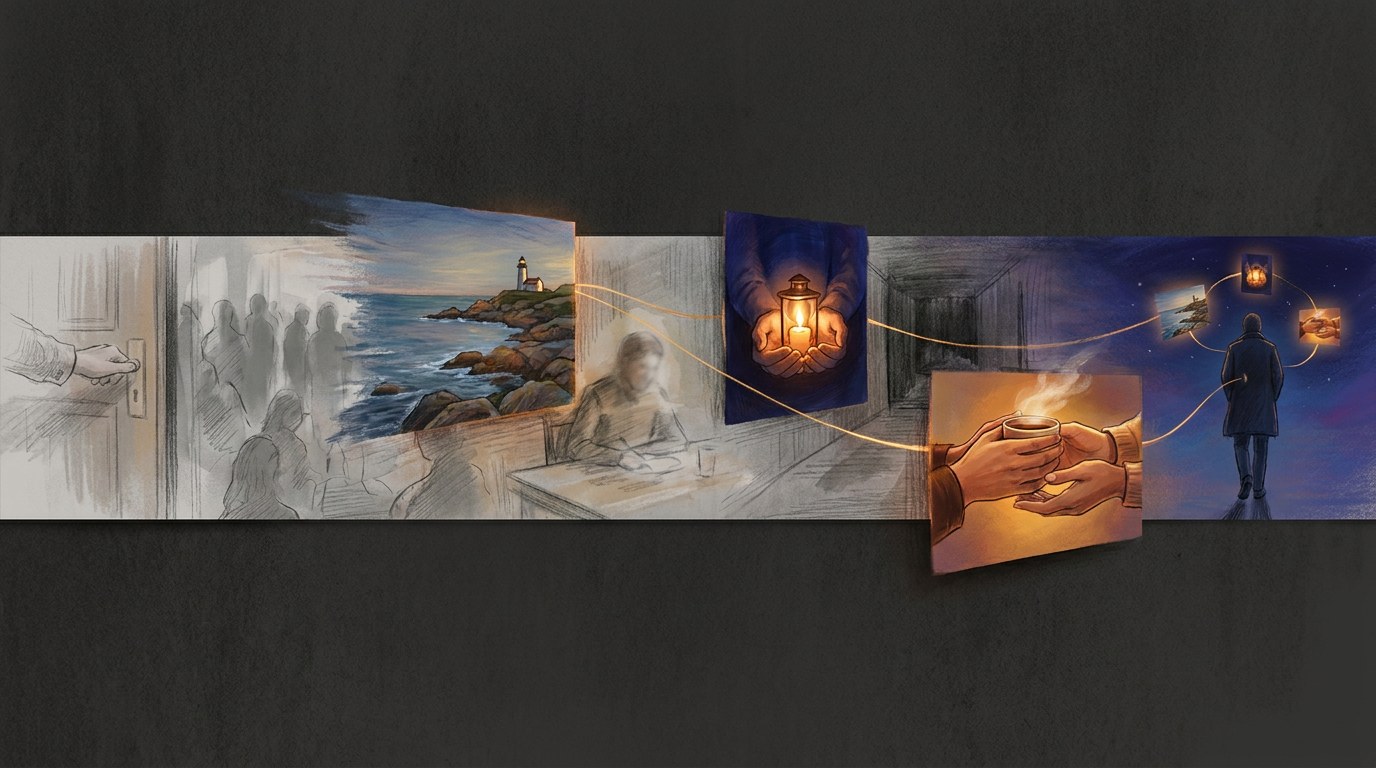
Memory also has a grammar. The brain does not record experience as a continuous stream; it segments it into events, and it places the boundaries at moments of change: a new location, a new goal, a new character, a shift in what is happening. Researchers who study this find that the brain's activity at these boundaries has a distinctive signature, as if a file were being closed and a new one opened. People remember events better when the boundaries are clear, and they lose track of details across them, which is why walking through a doorway can make you forget what you came for. The doorway ended a chapter.
For a designer this is a gift. A change of light, a narrowing of the sound field, a curtain, a threshold crossed, a performer's shift of purpose: these can be composed to give an experience clear chapters, and clear chapters are what memory can hold. It need not be loud. A pause and a single invitation can make a sharper boundary than an elaborate transition.
Memory is not a recording
One final fact undoes the last of the camera metaphor. Memory is reconstructive. Each time an event is recalled, it is partly rebuilt from fragments, colored by the present, and stored again in its revised form. The same machinery that recalls the past is used to imagine the future: people with damage to the hippocampus struggle not only to remember scenes but to invent them. Memory and imagination are two uses of one system.
The implication for shared environments is generous. What a visitor takes home is not a copy of what was shown; it is something they made, from what they noticed, what they felt and what they brought. The stronger the emotional shape, the clearer the chapters and the kinder the ending, the more of the making the environment can guide. But the making is theirs, and it goes on for years.
Everything in this first part points the same way. Reality, for a person, is built at the body's edge and finished in the mind, from light, pressure, molecules and contact, gated by attention and fixed by feeling. A room that understands this is not a container for an experience. It is a participant in one.