How Experience
Becomes Meaningful.
A place can be vivid and still mean nothing. What turns sensation into significance is the mind's own contribution: the imagination that fills in what is withheld, the private associations each person carries, the structuring power of music, the living presence of a performer, and the oldest technology we have for sharing minds, which is story. This is part three of the Qualia Forge thesis; it concludes with what all of this makes possible.
Imagination: The Mind Supplies What the Room Withholds
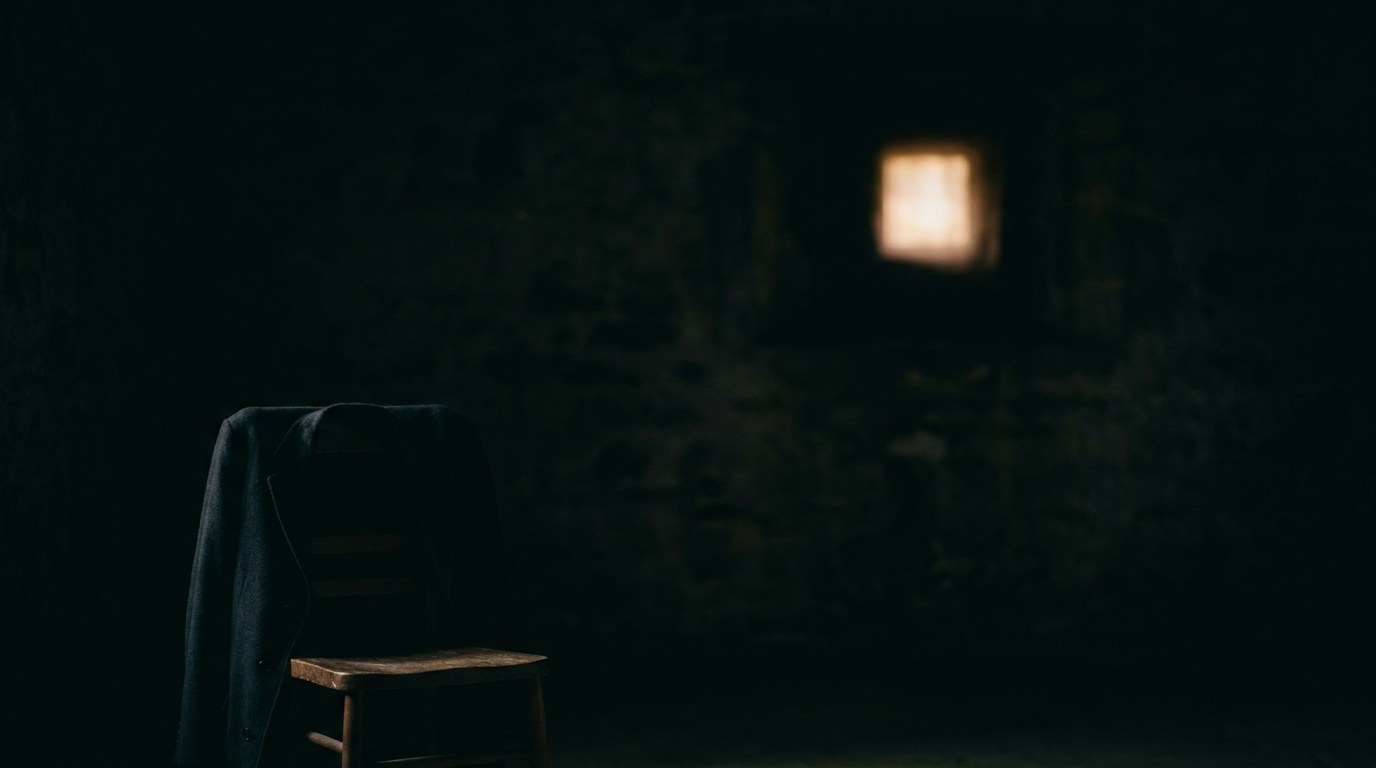
The most important thing in any composed environment is what is not there. A door that is never opened. A conversation half-heard from another room. A landscape with one unexplained light. A chair, warm, whose occupant has just left. These absences are not gaps in the design. They are invitations, and the visitor's mind accepts them before it has been asked.
We saw earlier that memory and imagination run on the same neural machinery: the hippocampus and its network build past scenes and possible scenes with the same tools. This system is not idle when the world is quiet. Neuroscientists studying what the brain does when it is given nothing to do found, to their surprise, that a large, consistent network becomes more active, not less. This default network is what runs when you daydream, remember, plan, imagine another person's thoughts or construct a scene that never happened. It is the mind's story-making engine, and it switches on the moment attention is released.
A room that fills every second and every surface never lets this engine start. A room that knows when to withhold gives it work, and the work it does is the most intimate thing a visitor will carry away, because they did it themselves. The story they finished is theirs in a way no story they were told could be.
Negative space
Artists have always known this in practice. The Japanese aesthetic concept of ma refers to the interval, the pause, the empty space between things that gives the things their meaning. A rest in music. The unpainted paper in an ink landscape. The silence after a line of poetry. In a composed environment, ma is the darkness held between two lit scenes, the wall left blank while everything else is alive, the scent that has gone before the thing it announced arrives. These intervals are where the visitor's imagination does its most vivid work, and they are the hardest thing for a nervous production to leave alone.
Suggestion is more powerful than depiction because it recruits the visitor. Show a monster and you have a monster of a certain size, moving in a certain way, that half the room finds unconvincing. Show a shadow, a sound from behind the wall, and the shudder of a rail, and every person in the room has a monster of exactly the size that frightens them. This is not a trick. It is respect for the audience's own capacity, and it is the oldest principle in theatre.
Every visitor arrives with a lifetime of material we did not supply. The generous thing, and the powerful thing, is to leave room for it.
Association: The Private Dictionary
Marcel Proust dipped a small cake in a cup of tea and found a childhood he had thought lost, and in doing so he gave psychology its most famous example of a mechanism it has since studied in depth. Association is the linking of one experience to another such that the first calls up the second, and it is the fundamental way meaning attaches to the world.
Some associations are built by a lifetime of pairing: the smell of a particular soap and a particular person; a piece of music and the year you first heard it. Some are shared across a culture: a certain shade of red, the shape of a cross or a crescent, the sound of a bell. Some appear to be built into the body, or nearly so. People across cultures tend to match high pitches with small, bright, upward things and low pitches with large, dark, downward ones. They match rounded shapes with soft sounds and spiky shapes with sharp ones. Warm colors advance and cool colors recede; a slow rhythm calms and a fast one excites. Designers work with this shared grammar constantly, whether they name it or not.
What makes association powerful in a room is its speed and its indifference to reason. A visitor does not decide to feel that the blue light means loss; the association fires before decision is possible, colored by everything in their history that blue has ever accompanied. And because the histories are different, the meanings are different. The same environment is a different place for each person in it. This is not a flaw to be engineered away. It is the medium's nature, and a mature practice designs for it: composing the external conditions with great precision, and then remaining curious about what people actually feel.
Building a vocabulary in the room
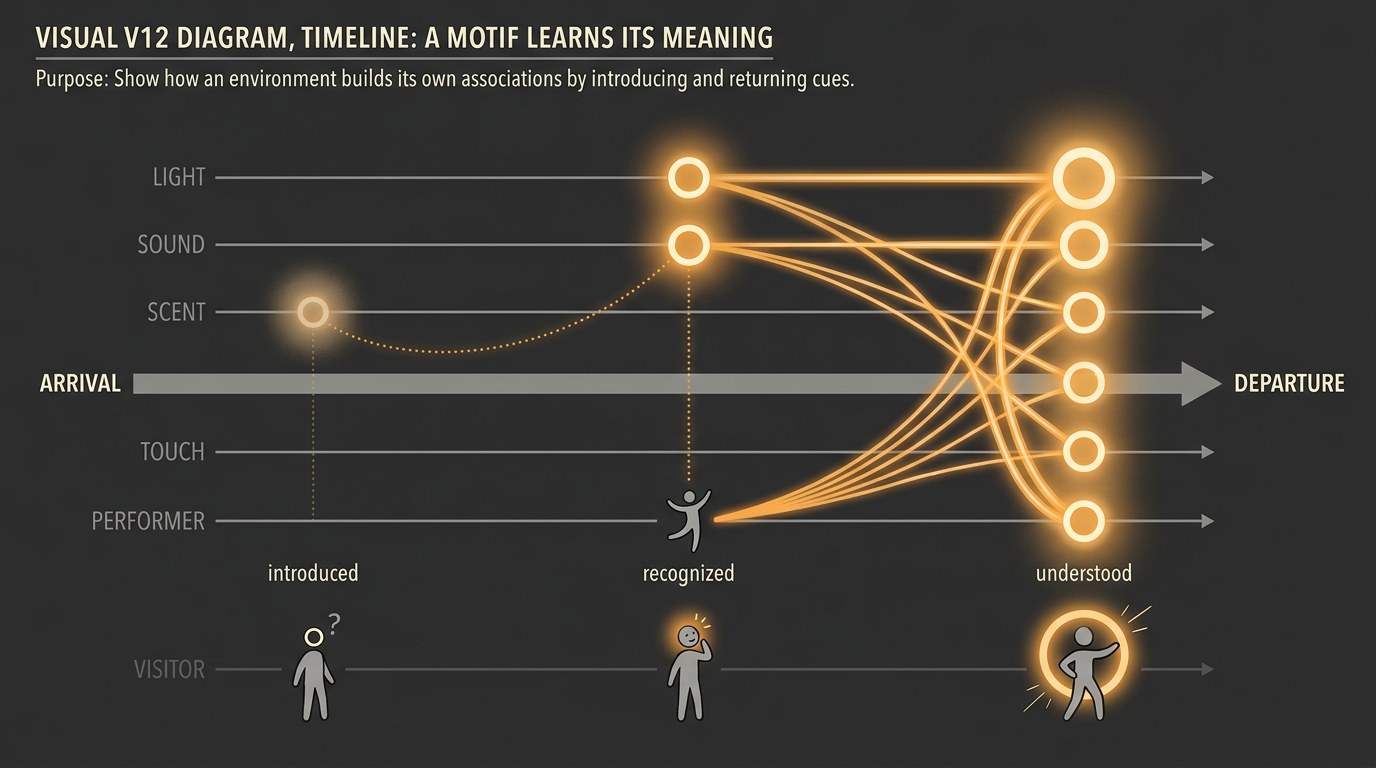
Because private associations cannot be controlled, the most reliable method is to build new ones during the experience itself, and then use them. A composer does this with a motif: a phrase introduced quietly, associated with a character or a place, and returned later with the weight of that association behind it. An environment can do the same with anything it can repeat. A particular quality of light that accompanies one character; a chord that sounds when a door opens; a scent, faint, at the entrance, that returns at the climax; a temperature. The first appearance teaches; the return means. By the end, the production has a private language shared by everyone in the room, and a single cue can carry an entire history.
Repetition with variation is the key. A symbol seen on a letter, then made as a gesture by a performer, then appearing at architectural scale on the wall, is understood the third time in a way that no explanation could achieve. The visitor has learned it, and learning is the deepest form of attention.
Music: Time Made Audible
Of all the arts, music has the least to say and the most to do. It depicts nothing, and yet it can produce chills down the spine, tears, a lump in the throat, a wish to move, in listeners who could not explain what any of it means. It is the art most directly wired into the machinery of emotion, and the mechanism is now reasonably well understood.
Music is organized expectation. From the first few notes, the brain begins predicting what will come next, drawing on a lifetime of listening to build a model of the piece's rules. Every prediction is a small bet, and the music pays out in a currency the brain cares about deeply: fulfilled expectations, delayed expectations, and surprises that turn out to make sense. Studies using brain imaging have found that the anticipation of a beloved musical passage releases dopamine in one part of the reward system, and that the arrival of the passage releases it in another, the same circuitry engaged by food, and by other of life's deep pleasures. The chill that runs down the spine at a musical peak has been tracked to the moment the expectation resolves.
This is why music is the most powerful tool available for shaping the feeling of time in a room. Tension and release, repetition and departure, the slow build and the sudden silence: these are not decorations on an experience. They are the experience's emotional structure, laid out in sound, and the body follows them whether or not the mind is paying attention.
Bodies in time
Music does something else that no other art can. It synchronizes bodies. A rhythm played in a room causes the people in it to move, minutely, in time with it: a nodding head, a tapping foot, a shift of weight. Researchers call this entrainment, and it begins in infancy and is rare among other animals. When a group of people entrain to the same beat, their movements align, their breathing aligns, and, as we saw earlier, their hearts begin to align. Music is the fastest route to the collective effervescence Durkheim described, which is why nearly every gathering ritual in human history has involved it.
Music that has a place
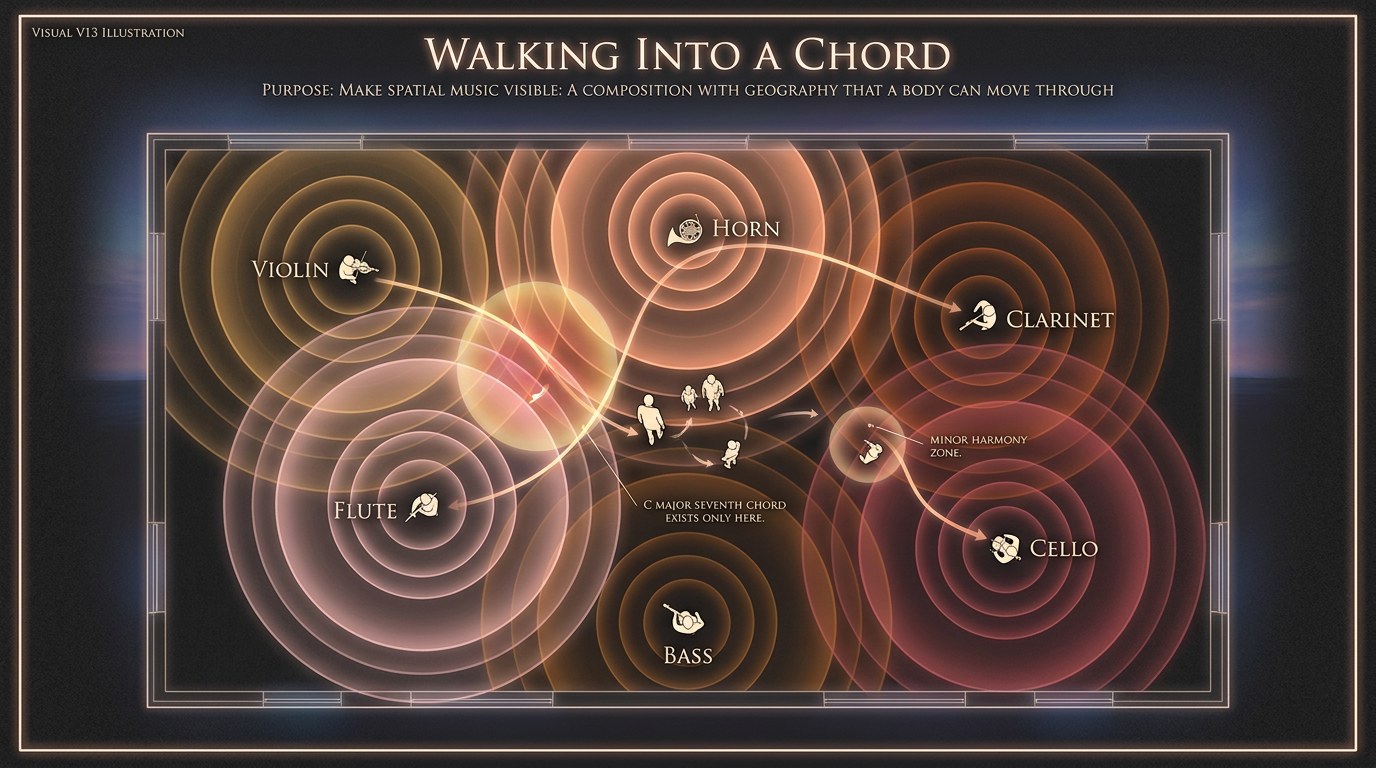
Ordinarily we hear music as coming from one direction, or from no direction, filling the room. In a composed environment, music can have geography. Separate voices of a composition can occupy separate locations, so that a melody is heard on the left and its answer on the right, a bass line beneath the floor and a high line overhead. A visitor can walk into a chord. A dancer can connect the places where instruments live. A phrase can move through the room, or be repeated from a distance as if by memory. The composition becomes something to be inside rather than in front of, and the body's movement becomes part of the mix.
This changes what a concert can be. Not a stage and a facing crowd, but a place whose acoustic weather changes as the piece unfolds, with real musicians visible in it, breathing and adjusting together, and an audience free to move through the relationships between them.
Performance: A Living Intention in the Room
Thirty thousand years ago, in the caves of what is now France and Spain, people painted animals on walls that could be seen only by firelight. Researchers who have studied the images in the flickering light of a reconstructed lamp report that the animals appear to move: legs multiply, heads turn, a herd surges across the rock. The paintings were made for that light, in a chamber whose acoustics, we now know, were among the most resonant in the cave systems. Someone stood in that space, with the fire and the echo, and told a story. Immersive performance is not a new medium. It is the first one.
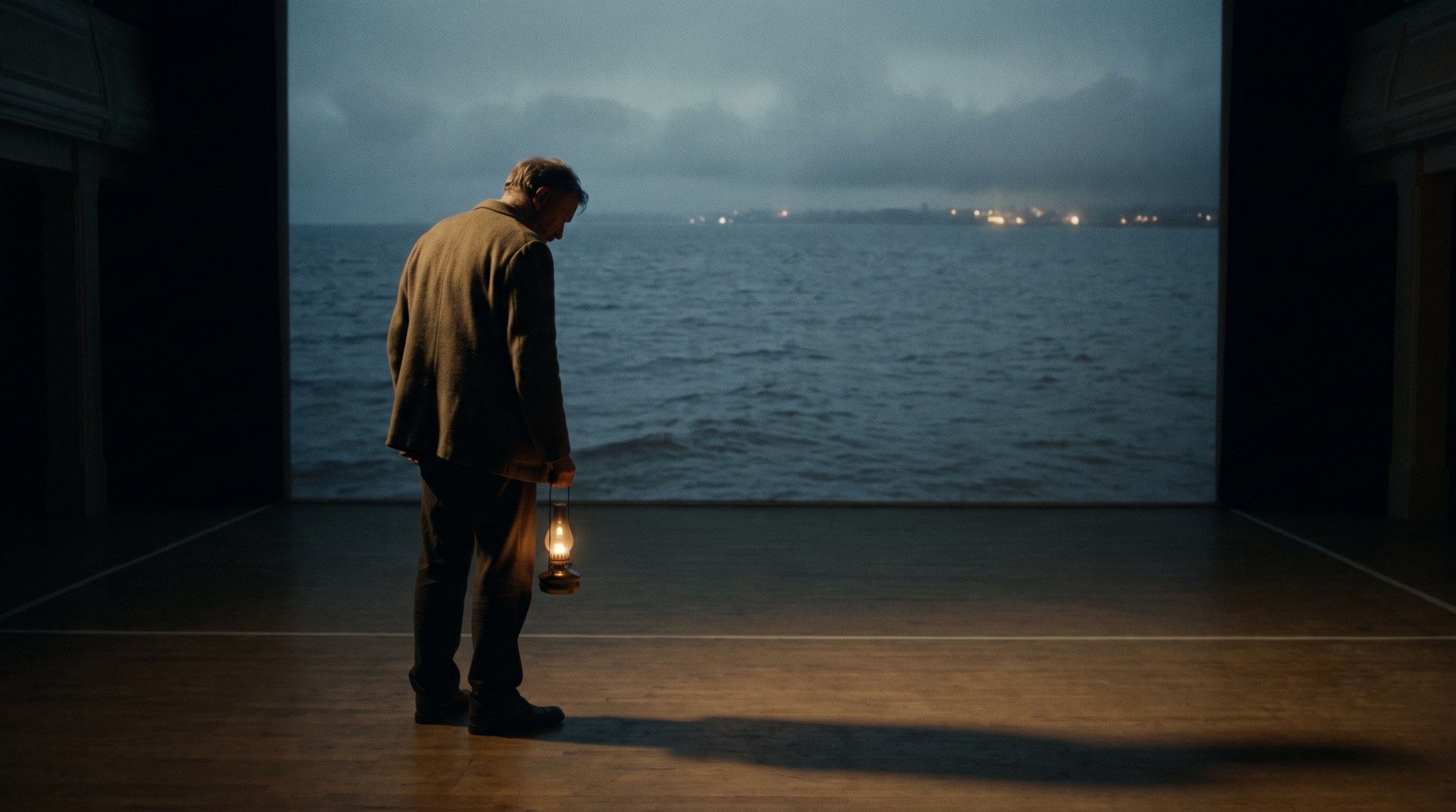
What a performer brings to a room is something no system can supply: a living source of intention. An actor can wait. They can notice the person who is confused and slow down; the person who is bold and give them room; the person who is frightened and offer a hand. They can redirect the attention of forty people with a glance. They can make an impossible image emotionally credible by having a relationship with it: a projected sea is scenery until someone stands at its edge and grieves.
This is Slater's plausibility made flesh. The moment a performer responds to something a visitor has done, the environment stops being a display and becomes a situation. The visitor is no longer watching a place. They are in one, with someone, and something is at stake.
Liveness
There is a particular quality to events that are happening now, in this room, and cannot be replayed. Audiences feel it and seek it out; it is why people pay to see a musician perform songs they own recordings of. Part of it is risk: the performer might fail, and that possibility charges every moment. Part of it is uniqueness: this performance belongs to this gathering and no other. Part of it is reciprocity: the performer can feel the audience, and the audience can feel being felt. A recorded voice speaks to everyone and to no one. A live one speaks to you.
The performer among the machines
In a composed environment, the performer works with light, sound and image as partners, and the relationship runs both ways. A performer can time a reveal to the moment the room is ready, rather than the moment a clock says. The room can respond to the performer: a step toward the wall and the horizon brightens; a raised hand and the sound narrows to a single voice. The most sophisticated technical systems become interesting in this company, because they are no longer executing a timeline; they are in a conversation.
Dance carries this furthest. A body crossing a projected boundary can expose an illusion or complete it. A repeated movement can bind two places in the room together. Choreography works in the same units as architecture, distance, direction, weight, and it can make the relationships in a space legible to people who share no language with the performer.
Story: The Oldest Technology for Sharing Minds
Every human culture tells stories, and every human child begins to understand them before the age of three. Story is not entertainment layered on top of cognition. It appears to be one of cognition's native formats: the way we organize events into cause and consequence, understand other people's intentions, remember the past and rehearse the future. Our brains, some researchers argue, are story processors before they are logic processors.
The evidence for how deeply story reaches is remarkable. When people listen to the same narrative, their brain activity becomes coupled, rising and falling together across large regions of cortex, in a way that does not happen when they listen to the same sounds scrambled. When a speaker tells a story and a listener understands it, the listener's brain activity comes to resemble the speaker's, and the closer the resemblance, the better the understanding. Stories, quite literally, bring minds into alignment. When a story absorbs us, we show the phenomenon psychologists call narrative transportation: attention narrows, the real surroundings recede, emotion tracks the characters', and beliefs shift afterward in ways that direct argument rarely achieves.
Story also gives change a consequence. Sensation without narrative is a sequence of impressions; the same sensations organized by someone wanting something, meeting an obstacle, choosing, and being changed become an experience with a shape. The shape is what memory can hold. It is also what makes an ending an ending rather than a stop.
Story in a room
A story that is told in a space rather than on a page or a screen has different possibilities and different obligations. It can be distributed: across objects, across surfaces, across people, across the route a visitor takes. A workshop entered after its occupant has left, tools still warm, a message unfinished; then a sound from outside that changes what those details mean. The visitor assembles the story from evidence, and the assembling is the pleasure. The story a person pieces together is more theirs than the one they are told.
It can also be shared unevenly. Two visitors in the same room, standing in different corners, may witness different parts of the same event, and discover afterward that they hold complementary halves. In cinema this would be a failure of continuity. Here it is a feature of the form: the story completes itself in conversation, and the conversation is part of the work.
The obligations follow from the possibilities. Because attention is not guaranteed, essential relationships must survive a missed line or a blocked view. Because routes vary, the story must be satisfying at more than one depth: complete for the person who follows every thread, and complete, differently, for the person who mostly wanted to wander. Because a room cannot cut, transitions must be built from the body's own punctuation: thresholds, darkness, sound, a performer's crossing. And because endings are remembered above all else, the ending must be given room. Not a spectacle; a resolution, and then a place to stand while it settles.
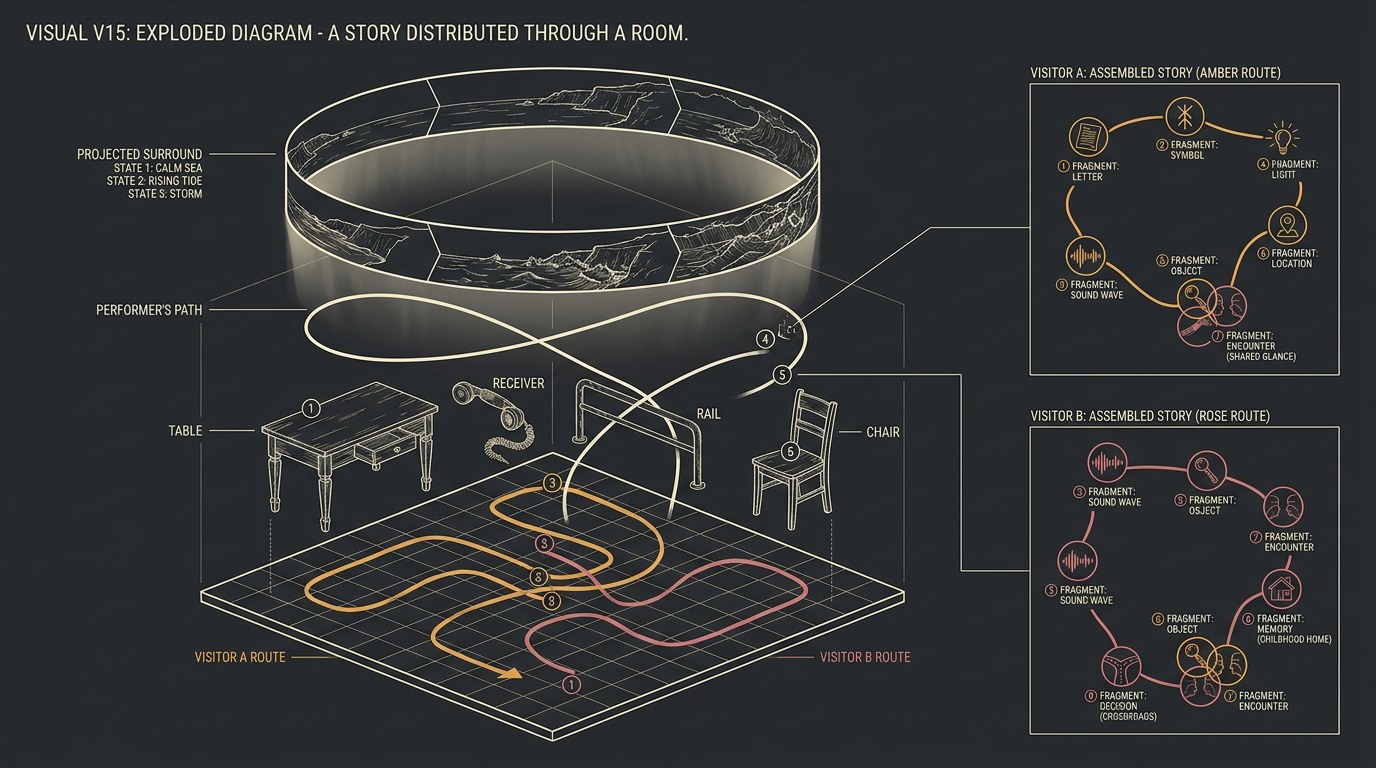
Sensation becomes meaning when a mind does something with it: fills a silence with imagination, recognizes a returning cue, follows a musical phrase to its resolution, meets a living intention, or assembles a story from evidence. A composed environment cannot make meaning for anyone. It can only make the conditions in which people make it, together, and that is what we mean by the art of being somewhere.