How We
Experience Place.
A room is a volume of air enclosed by surfaces. A place is something else: a location that has been lived in, oriented within, shared and felt. The transformation from one to the other happens inside the visitor, and it follows rules that can be learned. This is part two of the Qualia Forge thesis; it continues into how experience becomes meaningful and what this makes possible.
Space Becomes Place
The geographer Yi-Fu Tuan put it in a sentence: space is freedom, place is security. Space is the open field, undifferentiated, full of possibility and slightly threatening. Place is the field once you know where the gate is, where the shade falls in the afternoon, where you sat with someone last summer. We are attached to places, and we make them constantly, out of raw space, by the simple act of being somewhere long enough to orient ourselves and care.
The making begins with orientation. From the moment you enter a room, your brain is building a map, and it does so in two coordinate systems at once. One is centered on your body: ahead, behind, left, within reach. The other is centered on the world: the door beside the stairs, the window on the north wall, relationships that stay true no matter which way you turn. Neuroscience calls these egocentric and allocentric frames, and the ability to move fluidly between them is what lets you walk across a dark room toward a remembered chair, or point toward home from a city you have never visited.
The map in the head
In 1971, recording from the brains of freely moving rats, John O'Keefe noticed something that would win him a Nobel Prize four decades later. Certain neurons in the hippocampus fired only when the animal was in a particular part of its enclosure, and were silent everywhere else. Move the rat to a new corner and a different cell fired. He called them place cells, and he proposed that the hippocampus, already known to be essential for memory, was also a cognitive map.
In 2005 May-Britt and Edvard Moser found the map's coordinate grid. In the entorhinal cortex, one step upstream from the hippocampus, they recorded neurons that fired not at one location but at many, arranged across the floor of the enclosure in an astonishingly regular pattern of triangles, a hexagonal lattice laid over space. These grid cells give the brain a metric, a way of measuring distance and direction as the body moves. Around them, other populations were found: head-direction cells that act as a compass, border cells that fire when an edge is near, and cells that track speed. Together they form a positioning system, assembled from the body's own movement and corrected by landmarks, that runs in every one of us every moment we are awake.
Two things about this system matter enormously for anyone who builds environments. First, it is anchored by landmarks and boundaries. When the walls of an enclosure are stretched, place fields stretch with them; when a prominent cue is rotated, the whole map rotates. The brain's sense of where it is depends on stable references in the world. Second, the same hippocampal circuit that maps space also stores memory. This is not a coincidence. Episodic memory evolved out of navigation; we remember what happened by remembering where it happened. The ancient Greek technique of the memory palace, in which facts are placed in the rooms of an imagined building and recalled by walking through it, works because it borrows the brain's spatial machinery for another purpose.
We remember what happened by remembering where it happened. Give a moment a place, and you have given it a home in memory.
For design, the inference is direct. Landmarks, boundaries and the chance to move among them are not scenery. They are the scaffolding the visitor's brain uses to build a place at all, and they are the scaffolding memory will later use to find the experience again. An environment in which every surface transforms constantly can be spectacular and yet leave the visitor with nowhere to stand, no map, and so nothing to remember. Keep one physical thing stable, a table, a rail, a doorway, and the changing world around it has an anchor to turn about.
Presence: The Feeling of Being Here
Every person who has stood inside a well-made environment knows the feeling, and almost nobody can describe it. It is not belief. You know perfectly well where you are. It is something more like the body's quiet decision to treat this place as the real one: shoulders orienting to the projected horizon, feet adjusting to a floor that has not moved, breath timing itself to the room's sound. Researchers call it presence.
The most useful account of presence comes from Mel Slater, who spent decades studying it in virtual reality and concluded that it is not one thing but two. The first he calls place illusion: the sensation of being in the depicted place, even while knowing you are not. It arises from the sensorimotor loop. When you turn your head and the world responds as a world should, when you step forward and the scene changes appropriately, when a sound comes from where its source appears to be, the brain's predictions are confirmed at every turn, and the model settles into the place. Place illusion is about the body's relationship to the space.
The second he calls plausibility: the sense that what is happening is actually happening. This has nothing to do with realism of rendering and everything to do with coherence and personal relevance. If a character in the environment looks at you when you move, responds when you speak, reacts to the same event you just reacted to, the situation acquires a credibility no amount of pixel detail can provide. Plausibility is about the world's relationship to you.
The two can come apart. A photographically perfect room in which the projected inhabitant ignores a loud crash has place illusion and no plausibility. A plain room in which a performer notices that you have stepped back and adjusts to meet you has plausibility in abundance. The strongest experiences have both, and the second is often the cheaper and the more powerful.
Presence should also be distinguished from enjoyment, from attention and from emotional involvement. A person can be entirely present in a frightening room and want very much to leave. Another can follow a story with complete engagement while never feeling transported. These are different states, and a designer who conflates them will misread every audience.
The body at the center of the circle
Why does presence come so much more readily in a physical room than on a screen? Part of the answer is peripheral vision. A screen, however large, has an edge, and the periphery, the part of the visual system that tells us where we are, sees the edge and the room beyond it. When the image extends past the periphery, into the far corners of the eye and behind the head, there is no edge for the periphery to report. The world simply continues. Immersion, in the literal sense, is the removal of the frame.
Part of the answer is the body itself. On a screen, the visitor is a point of view. In a room, they are a body: they cast a shadow, they take up space, they can be approached, they can move toward what interests them and away from what does not. Every one of those capacities confirms, through the sensorimotor loop, that they are somewhere. The philosopher Maurice Merleau-Ponty argued that we do not have bodies; we are bodies, and that all perception is the body's grasp on the world. Presence, in a shared physical environment, is that grasp being given a world worth holding.
Scale and the Body
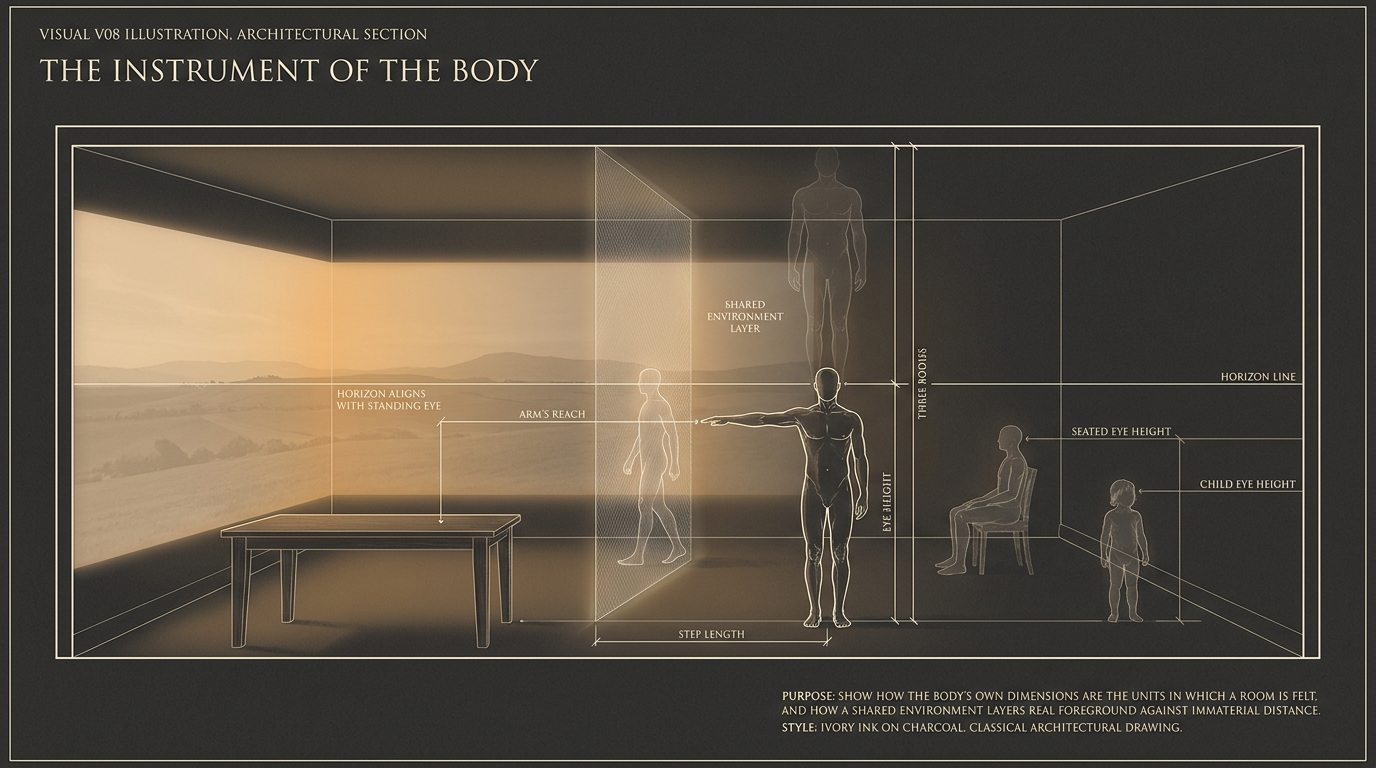
We measure the world with ourselves. A step, a reach, a span of the arms, the height of the eye: these are the units in which we first learn size, and they remain the units in which we feel it. Architects have always known this. A door slightly lower than a person's raised hand feels intimate. A ceiling three times their height feels ceremonial. A space whose far wall cannot be judged by eye, because nothing of known size stands between here and there, feels infinite, and slightly unnerving.
Scale is registered before it is reasoned. Cathedral builders discovered that height produces awe, and modern studies have begun to describe the mechanism. Awe, the emotion elicited by vastness that exceeds our existing frame of reference, has a measurable profile: attention broadens, the sense of self shrinks, time seems to slow, and people become more generous and more willing to affiliate with those around them. Researchers who have studied ceiling height alone find that higher ceilings shift thinking toward the abstract and the free, while lower ceilings encourage focus and detail. The room is already shaping the mind before anything is shown on its walls.
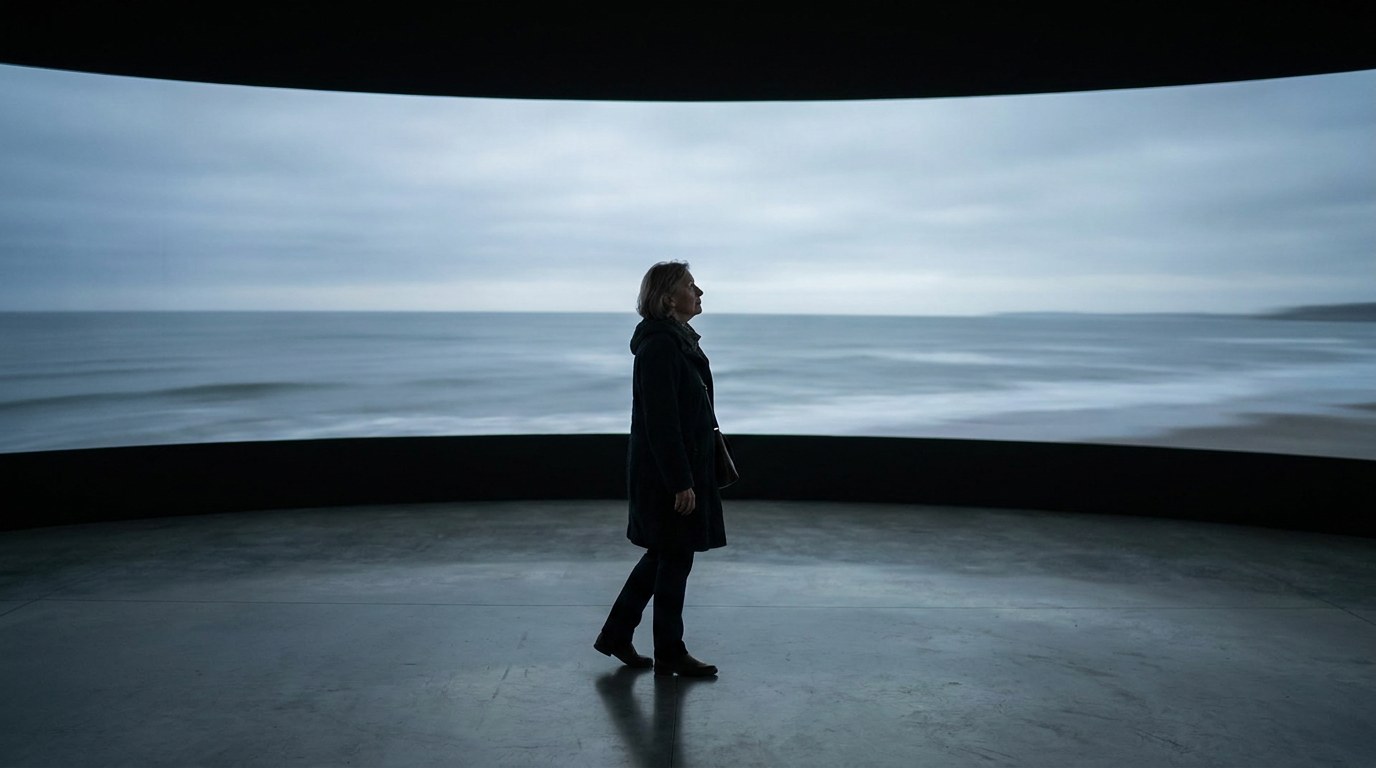
Peripheral vision is central to this. Because the periphery is tuned to motion and to large, low-detail structure, it is the channel through which scale and enclosure are chiefly felt. A large image seen in the center of vision is information. The same image extended into the far periphery is an environment. This is why the difference between a screen and a surround is not a matter of degree. Past a certain angular extent, the periphery stops reporting an edge, the brain stops modeling a picture and starts modeling a place, and the body responds accordingly: posture, balance, breath.
Two scales at once
The most affecting places hold two scales together. A vast image and a small object. A distant horizon and a hand within reach. The eye travels between them and the body understands, from that travel, its own position between the intimate and the immense. A single warm stone placed in the hand while the walls show a mountain range is a more complete experience than either alone, because it gives the visitor both ends of their own measuring instrument.
Real foreground objects do something projection cannot. A projected scene supplies the same image to every eye in the room; as a visitor moves, the perspective on the far wall does not change with them. Their brain notices this, quietly, and files the far image as a picture. A real table, a real rail, a real doorway, standing between the visitor and the image, provide the parallax that a moving body expects: as you walk, the near thing slides across the far thing, and depth is confirmed by the very motion that would otherwise expose the illusion. Physical foreground, immaterial distance: this is one of the fundamental compositions of the medium.
Movement: We Know a Place with Our Feet
Perception is not something that happens to a stationary observer. The psychologist James Gibson spent his career insisting on this, and his central insight has only grown more persuasive: we perceive in order to act, and we perceive by acting. The world presents itself to a moving body as a field of affordances: surfaces that can be walked on, edges that can be grasped, openings that can be passed through, distances that can be closed. A chair is not perceived as a shape and then interpreted as sit-able. It is perceived as sit-able. That is what it looks like to a creature with legs.
Movement also generates its own information. As you walk forward, the entire visual field streams outward from the point you are heading toward, faster near you and slower in the distance. This optic flow tells you your speed, your direction and the layout of everything around you, and the brain reads it with precision. It is why a large image that moves can make a standing body sway, and why a landscape that fails to flow correctly as a visitor walks toward it is instantly, wordlessly, understood as a wall.
Thresholds
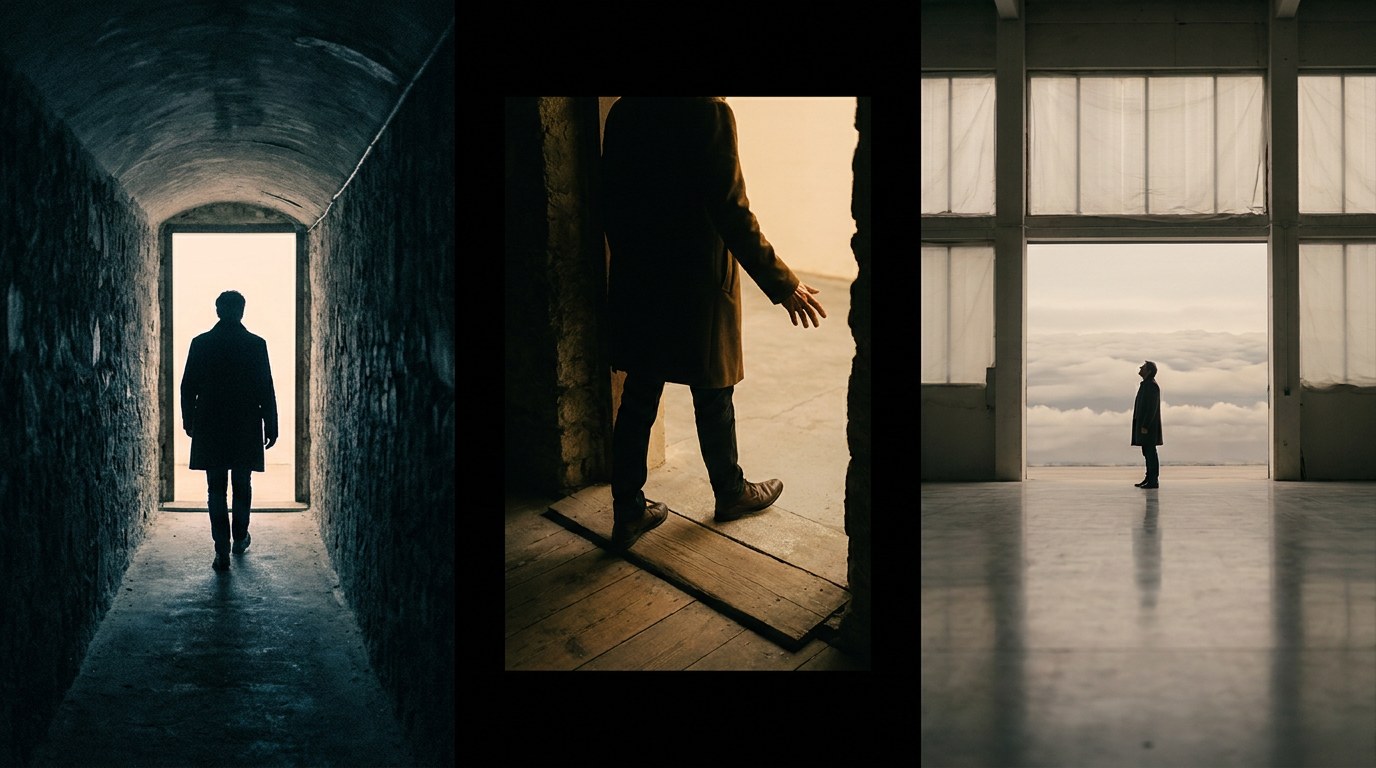
Of all the ways a body can move through a place, one has a special power: crossing a threshold. Anthropologists have documented, in culture after culture, the ritual weight of doorways, gates, the line between one kind of space and another. The brain, it turns out, agrees. Passing through a doorway is one of the most reliable triggers of an event boundary, the moment memory closes one chapter and opens the next. Experiments show that people forget more of what they were carrying in mind after walking through a door than after walking the same distance across an open room. The doorway is not just architecture. It is punctuation.
This gives designers of shared environments a tool with no equivalent in cinema. A film cuts; a room cannot. But a room can make the audience cross a line, and in crossing it they will, with no instruction, put down one state of mind and pick up another. A corridor that narrows before opening. A curtain. A step down. A change in the sound of the floor underfoot. Darkness held for three breaths between two lit spaces. These are the medium's equivalents of the cut, and they act not on the eye but on the whole body.
The route is the story
When people can choose where to go, the sequence in which they encounter a place becomes personal, and so does the place. Two visitors to the same environment may leave with different accounts because they took different routes, stood in different corners, arrived at the same moment from opposite sides. This is not a failure of design. It is a form of authorship shared between the maker and the visitor, and it produces a kind of ownership no fixed viewpoint can. The place I found is more mine than the place I was shown.
The freedom has to be composed. A visitor who can go anywhere needs reasons to go somewhere: a sound, a light, another person's movement, a glimpse through an opening. The oldest gardens in the world work exactly this way, revealing themselves in sequence along paths the visitor believes they chose. A shared environment is a garden of this kind, with weather that can be composed.
Other People: The Room Is Made of Us
There is a moment in a live performance when you notice that everyone near you has stopped moving. The room has become attentive, and that attentiveness is itself something you feel: a pressure, a warmth, a shared holding of breath. You did not decide to join it. You were already in it before you noticed.
We are the most social of animals, and our senses are built for it. A specialized region of the visual cortex responds to faces in well under a fifth of a second. Another tracks where other people are looking, and experiments show that we shift our own attention toward a gazed-at location involuntarily, faster than we could if asked. A cry of alarm in a crowd produces orienting in everyone within earshot before any of them has understood the words. Attention is contagious, and so is feeling.
The mechanism of that contagion has been studied at every level. When we watch another person act, populations of neurons in our own motor system become active as if we were performing the action, a mirroring that is thought to underlie our fluent understanding of other people's intentions. When we watch someone express an emotion, our facial muscles begin, minutely, to match it, and our own feeling follows. In audiences at theatres and concerts, researchers measuring heart rate have found that the hearts of strangers begin to beat in synchrony as the performance unfolds, and that the degree of synchrony tracks how absorbing the audience finds the work. A hundred people watching the same thing become, physiologically, something like one organism.
A crowd that has begun to breathe together is not a group of spectators. It is a single instrument, and the room is playing it.
The sociologist Émile Durkheim, watching religious ceremonies more than a century ago, named the feeling collective effervescence: the heightened, self-transcending energy of people gathered in shared attention and shared rhythm. It has since been observed in stadiums, at concerts, in protests, at funerals. Its ingredients are simple and ancient: bodies together, attention on a common object, movement or sound in synchrony, and a sense that the moment belongs to this gathering and no other. It is, arguably, the reason people leave their homes to be entertained at all.
The other visitor is part of the scene
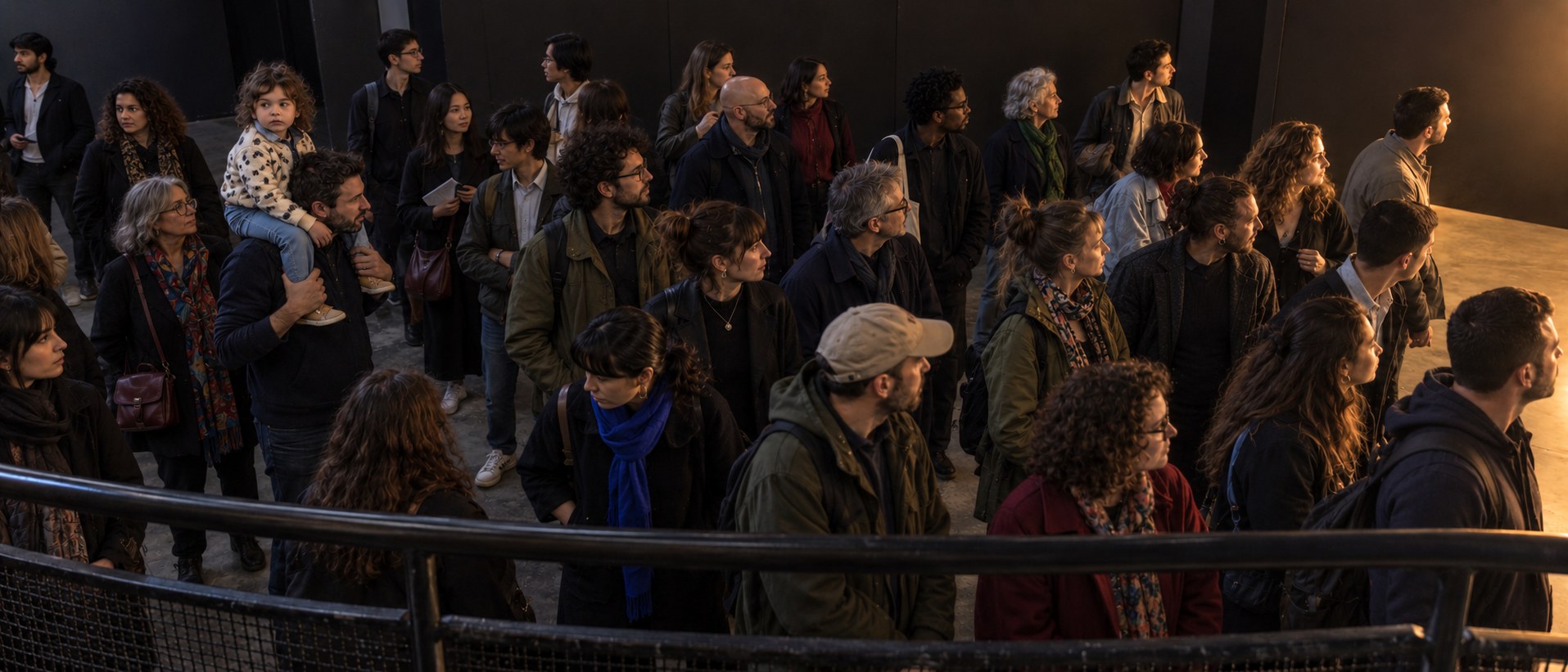
In a shared environment, other people are not an interference with the experience. They are the medium through which much of it travels. A performer looks toward a faint sound before the image appears; the visitors nearest to her follow her gaze; their turning heads are visible to visitors farther away, who turn in response. The cue has moved through the crowd like a wave through water, and by the time the image arrives, forty people are looking at the place it will appear. No technical system could have coordinated that as well as the audience coordinated itself.
Presence itself is strengthened by company. Seeing another person react to the same event you have just reacted to is powerful evidence that the event is real, in the sense that matters: shared. Slater's plausibility is, at bottom, a social judgment, and a room full of people confirming one another's reactions is the most persuasive plausibility engine there is.
Designing for the gathering
This has consequences for how a place is composed. Groups contain unequal confidence, height, mobility and social ease. The first person to touch something becomes, accidentally, the spokesperson for everyone. A quiet visitor at the back of a cluster cannot see the object the front is gathered around. A private moment that is magical for six people can become exclusion for forty. The geometry of a gathering is part of the design, and so is its etiquette: how people are invited, how they may decline, how they find one another again, and where they go afterward to compare what they saw.
That last is not an afterthought. The conversation after the experience, in which each person offers the fragments they noticed and discovers what the others found, is where a shared experience completes itself. It is how a room full of individual perceptions becomes, retrospectively, a common memory. A place to stand and talk, with something warm in hand, is part of the architecture of meaning.
A place, then, is a collaboration. It is made by the visitor's brain from landmarks and boundaries; confirmed by the body's movement and its grasp on real things; scaled to the human frame; and shared, socially, until a room of strangers becomes a single attentive presence. The task of a maker is to compose the conditions under which that collaboration can happen, and then to make room for what people bring.