Light on a Surface, or Light from a Surface.
A direct-view LED wall is a field of tiny lamps aimed at your eye. A projected image is light returned off a matte face, the way light arrives off every object the eye evolved to read. That single difference runs through pitch, viewing distance, comfort, sound, cameras and steel. The models below put numbers under it, honestly, so the comparison can be held in the open.
Everything here runs on the same arithmetic as the configurator and the projection planner, and nothing is hidden: where LED holds the advantage, the model says so in plain terms. Bring a plan from the planner and the comparison runs on your own wall. One honesty above all the others: these models are demonstrations. They exist to show you what to look for, not to spare you from looking.
00 · start from your setting
Every model on this page, and the closing ledger 11, recomputes to this setting.
A smarter alternative to indoor LED
Large-format impact, with the elegance of textile architecture.
Our screens are flexible, textile-based projection surfaces delivering deep blacks, controlled light behavior and cinematic imagery, even in bright environments. In many indoor settings they deliver equal or superior visual performance to LED walls. None of that is asked to be taken on faith: every claim on this list carries the number of the model that proves it, live, further down this page.
What that buys
- Superior image depth with no visible pixel structure 01
- No LED eye fatigue: comfortable for long viewing durations 04
- An organic, cinematic look instead of harsh emissive light 03
- No on-camera moiré artifacts 07
- Reflections and refractions return picture, not grid 08
- Seamless faces that curve, dome and wrap with no tiling lines 09
- Lightweight textile that integrates into scenic and architectural builds 10
01 · walk up to the wall
Both walls carry the same picture. Walk closer.
Distance decides what each wall is made of; walk in and watch both give themselves away. The venue is drawn in true perspective, one real still across both halves; the loupe under it shows each face as a normal eye resolves it, one arcminute. An LED pixel is a small emitter with dark aluminum around it. A projected pixel depends on its engine: DLP lays micromirror squares at better than 90% fill, 3LCD sits behind a softer aperture, LCoS all but closes the grid. Pick the engine and the picture, walk in, and drag the venue view to move around it.
This walk-up is a demonstration of what your eye will do; it is not the doing. Two meters from a real wall settles it in seconds. Request a demo.
02 · effective pitch
The pitch your projected wall actually has
Resolution is bought in projectors, not tiles, and the exchange rate favors light. Pixel pitch is just width divided by pixels, whoever makes the pixel. Set your wall and rig, and read the projected image as the tile world measures itself.
03 · the path the light takes
Emitted at you, or returned to you
Same picture, different physics at the retina. LED light leaves a semiconductor die and travels straight into the eye: a specular point, repeated two hundred thousand times per square meter. Projected light leaves a matte face in an even hemisphere: the eye reads a lit object, not an array of sources. Flip the venue lights and watch what each wall does with light that is not its own.
04 · viewing comfort
Light the eye can rest in
Fatigue is pupil work: emissive peaks make the eye commute, a projected image lets it settle. In a dark venue the eye adapts to the average scene, then meets the peaks. An LED wall can hold over 1,000 nits against a dark surround: the pupil closes, opens, closes again, and that cycling is what audiences report as fatigue. A projected image stays near 50 to 150 nits, the luminance regime cinema has held for a century because eyes stay fresh in it. Quality LED walls also refresh above 3,840 Hz to keep flicker below perception; budget tiles do not, and cameras find what eyes miss.
05 · the science of light
What the light is made of
Both land in DCI-P3 class; only one fills the middle of the spectrum. Every display is a spectrum before it is a picture. An LED wall emits from red, green and blue diodes; a laser-phosphor projector drives a broad phosphor field with a blue laser line, far narrower than any diode, and the phosphor fills the middle where diode skirts fall away. The shapes below are the argument.
What the middle of the spectrum buys on camera
Look at the stretch between the green and red markers, roughly 550 to 615 nanometers. The LED wall emits almost nothing there: its green diode falls away past about 550 and its red diode does not rise until about 615, so every yellow, amber, gold and warm skin tone leaving that wall is a two-band mixture that never contains the wavelengths those subjects actually reflect. The phosphor field is continuous across that whole stretch. A cinema camera reads the difference directly, because its color filters overlap in exactly that region: light with real energy at 570 to 600 nm lands across the red and green photosites the way daylight does, while a two-band metamer lands differently for the sensor than for the eye. That mismatch is why tri-band walls need per-camera spectral calibration and can still drift on faces.
- Golden-hour skin and backlit hair: 570 to 600 nm energy the diodes never emit
- Candlelight, firelight and tungsten practicals: continuous warm spectra, not a two-spike imitation
- Sodium streetlight at 589 nm, dead center in the LED null
- Sand, wheat, autumn foliage, brass and gold: reflectance curves that live in the mid-band
- Sunlit water and deep foliage greens: 500 to 550 nm carried as a band, not a spike
- The image as the key light: continuous mid-band light renders costume and skin naturally on talent
Honesty owed: on axis, for the eye, a calibrated LED wall reproduces most of these colors as convincing mixtures. The gap shows up through a camera, and in the light the wall throws onto the set. In an immersive environment or a virtual production volume the image is also the lighting, and a spectrum with a filled middle lights faces, water and costume the way the real scene would.
No spectrum chart shows you golden-hour skin; a face lit by both walls does. This is the halfway point of the page, and everything below deserves the same test in person. Request a demo.
06 · sound through the image
A wall you can hear through
Dialog should come from the face that speaks it; only one wall allows that. An LED wall is a rigid reflector: every speaker lives off the picture, and the voice arrives from somewhere the face is not. An Acoustically Transparent surface is an open weave: the speakers stand behind the image, the way cinema has rigged it for a hundred years. The weave takes a small, known, EQ-able high-frequency trim; the tile wall takes the whole conversation and bounces it back at the seats.
The trim, measured
Wide-band pink noise through the Acoustically Transparent build, a microphone at 5 m, 1/3 octave analysis. The whole cost of putting the loudspeakers behind the picture:
Where dialog lives, 250 Hz to 4 kHz, the loss is 1.15 dB; the low end passes almost untouched at 0.30 dB. The shape is a gradual tilt, not a resonance, so a shelf and a trim during normal alignment restore it. The full measurement and method are on the build data page.
07 · through the lens
Focus finds the grid
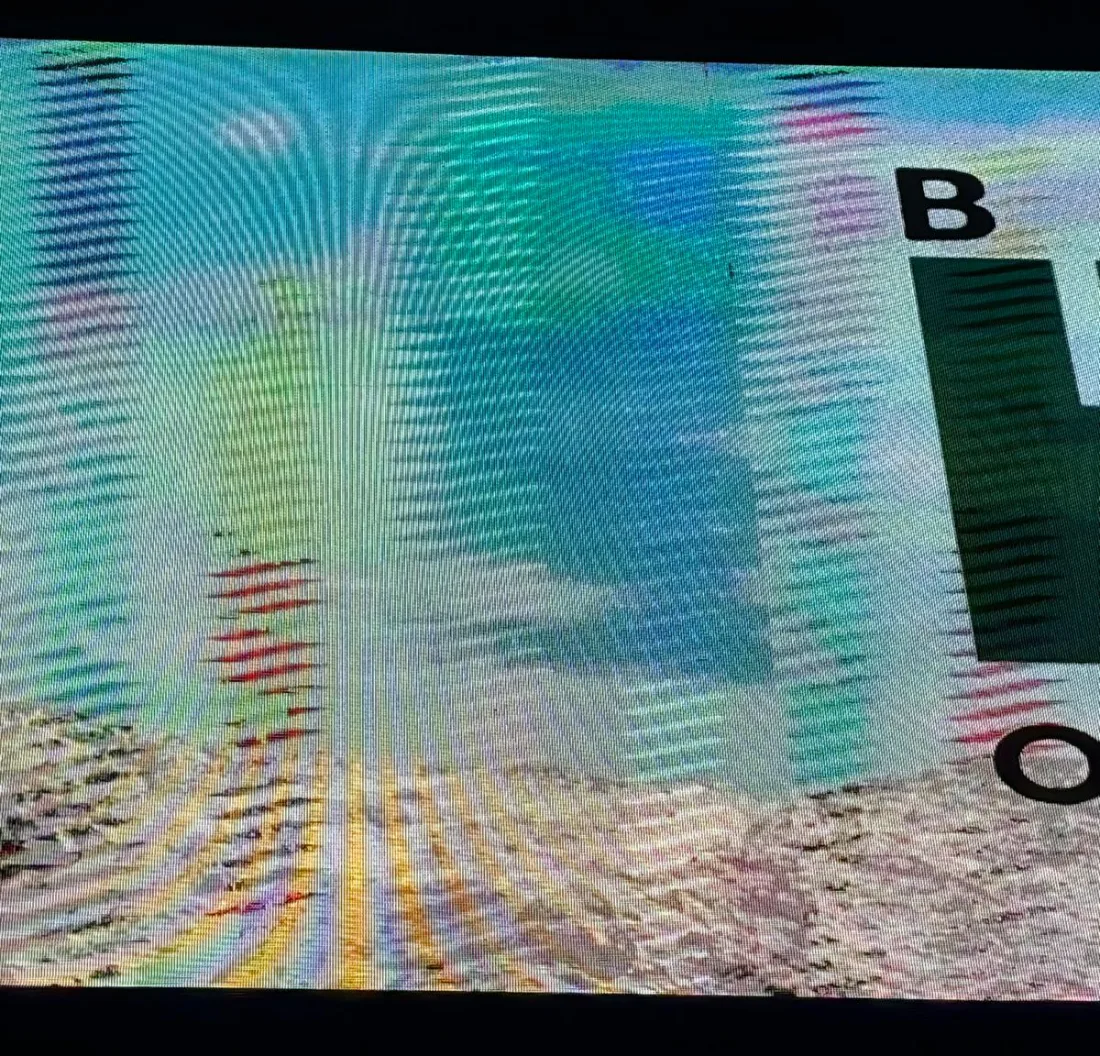
Focus is the test a lens applies without asking. In virtual production the wall lives through a lens. Rack toward the screen below: the tile face breaks out into its emitter grid and beats against the sensor as moiré; the projected surface simply comes into focus, picture on material. Honesty owed the other way: an LED volume also lights the talent with the scene’s own glow at serious output, an advantage projection matches only in controlled, dimmer setups.
Film and virtual production ready
Our screens perform exceptionally on camera and are used in virtual production environments at major production studios.
- No LED pixel moiré
- Natural light response on camera
- 180 degree viewing angles
- Actors see environments live
- Excellent for slow motion filming
- Works on curved stages
- Reduces reliance on green and blue screens
08 · reflection and refraction
Every glossy prop is a second camera pointed at your wall
The set re-images the wall through every reflection and refraction, and none of them asked the focus puller. The wall arrives again in the paint of the picture car, in the raked windshield, in the bottle and the water glass, and optics treats each as a new imaging system with its own focus. Below, one photographed set treated plane by plane: click anything in the frame and focus pulls to the depth that pixel actually presents, refraction included; the glass body keeps its own plane, only what it returns refocuses. Sweep the split, set the walls side by side or stack them, and watch the LED side hand the emitter grid back through every reflective and refractive surface at once, while the projected surface runs the identical optics with nothing periodic to re-image. Then stop the lens down: an LED volume forces wide apertures so its wall never resolves; a projected surface hands deep-focus staging back to the director of photography.
The curved body panel
A convex panel is a wide-angle mirror: for a distant wall the virtual image forms about half the panel’s radius of curvature behind the paint. On a tight curve, a crease line, chrome trim, glassware, that is effectively the surface itself. On a gently curved fender with a radius of a couple of meters it is a plane of its own, a step behind the car, so racking through the set the reflection sharpens just before the panel does, and neither moment is safe. The curve also demagnifies, so the emitter grid comes back finer than the camera saw it direct, deeper into the sensor’s alias zone. The same mirror pointed at a projected surface returns a matte picture, and a picture cannot beat against a sensor.
The laminated windshield
Windshield glass reflects from its outer and inner faces, roughly four percent at each, and the rake separates the two returns laterally by about the thickness of the glass. A periodic grid therefore comes back twice, slightly offset: the copies beat against each other before the sensor even joins in, which is why windshields moiré first on set. The simulation below carries the primary return; on set the offset twin only sharpens the effect. And because a nearly flat mirror keeps the reflected wall at the wall’s own optical distance, the windshield can carry a sharp grid while the car around it is still soft. A continuous image returns as one soft ghost pair and stays a picture.
The bottle and the water glass
A filled glass is a cylindrical lens with a focal length of about two radii for water. It forms a real image of the far wall just behind the glass, flipped left for right and compressed: the same optics lensball photographers use, a sharp miniature world while everything around it blurs. That image sits near the prop’s focus plane, not exactly on it, and above the waterline the glass has almost no power, so the background seen through the empty part stays soft while the water below carries a sharp one. One prop, three focus planes. Defocusing the wall does not help: the lens refocuses it.
Every optical claim in this module can be pointed at with a finger on our stage: a camera, a lens, glassware and both walls. Bring your own DP. Request a demo.
09 · corners, curves and seams
One face around every corner
A wrapped space lives or dies at its corners. LED cabinets are rigid rectangles: a corner is a seam between two flat faces, each aimed differently at every seat, shifting color and brightness against each other off axis. Projected light follows whatever the surface does: a fillet, a sweep, a full 270° wrap, one continuous image with the blends resolved in the beam. Below, the same corner built both ways; slide to walk across the space and watch what each face does with your line of sight.
10 · what the building carries
Steel, watts and heat
The tile wall spends per square meter of face; the projector spends per unit, and the gap widens with size. A tile wall distributes its mass across the whole face: cabinets plus the wall-within-a-wall steel that holds them. A projection build hangs grams per square meter and concentrates its mass in a few point loads at the rig. Power and heat follow the same shape. Typical published ranges, not vendor best cases:
Service is a fair fight: a failed tile module swaps from the face in minutes, which touring rightly loves; a laser projector runs 20,000 hours to half brightness with service at the rig, not on the image. Where LED spends its advantage: no throw volume needed in front of the wall, and a face that tolerates being touched.
11 · setting by setting
The honest ledger
The same physics lands differently in different settings. The ledger says plainly which instrument each point favors, in the setting chosen at the top of the page.
The ledger is an argument. The demo is the evidence: both instruments, your content if it can be got into the building, at the Hollywood, Los Angeles facility. Request a demo.